Showing posts with label Religion. Show all posts

Wednesday, October 2, 2024

"In God We Trust"

Each day my local paper contains a small column called "Today in History", listing things of note that happened on that day. I rarely read the column, but yesterday, for some reason, I did. It contained the following item:

"In 1957, the motto "In God We Trust" began appearing on U.S. paper currency."

I was surprised to realize I was alive when this happened, and so began another deep dive into the bowels of the Internet. Why did this happen? What did this phrase even mean back then? Why was it important to put it on all of our paper currency? Was anyone -- most notably constitutional scholars -- opposed to it at the time? As my brother-in-law would say, these were indeed some of the questions. As I spiraled down the rabbit hole, even more questions emerged.

The first thing I discovered was that "In God We Trust" is the official motto of the United States, approved by Congress and signed into law by President Eisenhower on July 30, 1956.


Some Background

Prior to 1956, the de facto motto of the U.S. was "E pluribus unum", Latin for "Out of many, one". This phrase hearkens back to our nation's founding, July 4, 1776, when the Continental Congress passed the following resolution for the creation of a national seal:

Resolved, that Dr. Franklin, Mr. J. Adams, and Mr. Jefferson, be a committee, to bring in a device for a seal for the United States of America.

It took six years, multiple committees and many designs before the Great Seal of the United States was approved. In the end, only one feature of the original committee's design remained untouched: the inclusion of "E Pluribus Unum" to boldly declare the birth of a unified nation from 13 individual colonies.
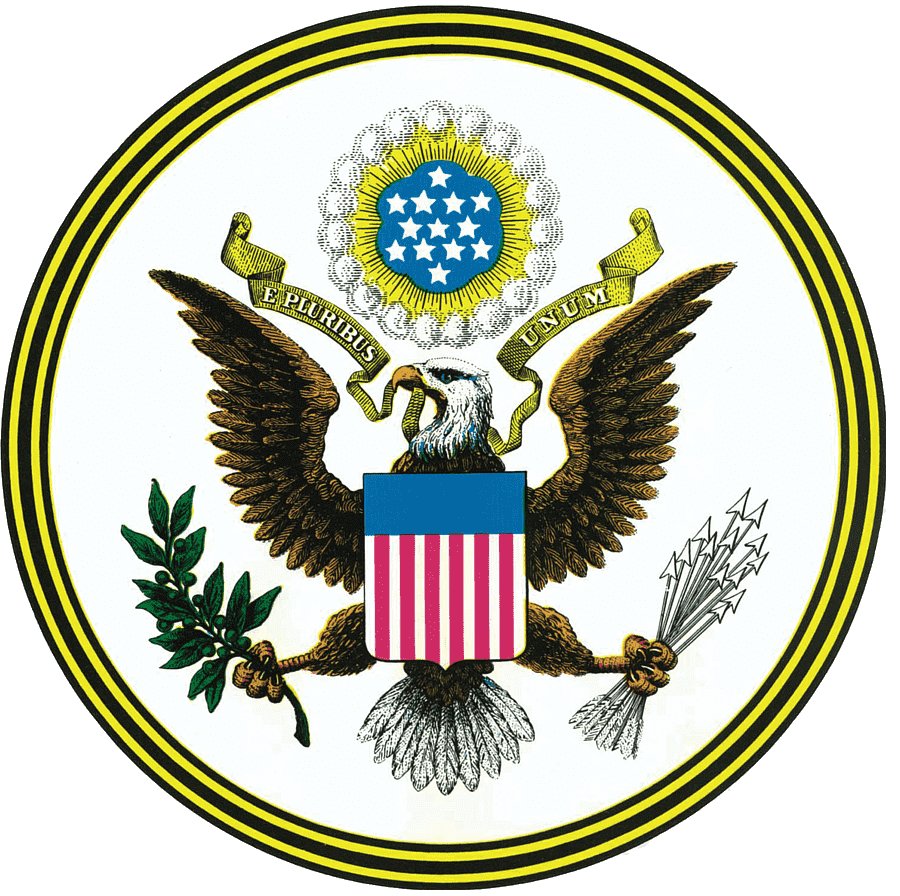
Learning this, a new burning question was immediately raised. What could have possibly caused the nation to believe that a lofty and patriotic motto such as this, created and designed by three of our most educated and respected founding fathers, should be replaced by "In God We Trust"?

Deeper Background

The use of "In God We Trust" dates back to the Civil War, when Reverend M.R. Watkinson, a Protestant minister from Pennsylvania, believed that the government needed to send a clear message that God was on the side of the Union and its army. In 1961, he decided to send the following letter to Samuel P. Chase, the Secretary of the Treasury Department:


Chase acted almost immediately, sending the following letter to James Pollock, Director of the U.S. Mint:

After some back and forth, Chase and Pollack decided that "In God We Trust" should be used as it was similar to "In God is our trust", a phrase found in The Star Spangled Banner. Following congressional approval on April 22, 1864, coins containing this new inscription began circulation.

A few northern newspapers questioned this change. The New York Times, in particular, wrote: "Let us try to carry our religion — such as it is — in our hearts, and not in our pockets". The general populace, though, approved of the change. The controversy disappeared and the inscription now appears on all U.S. currency.

It Finally Becomes the National Motto

In the early 1950's, the U.S. was embroiled in the Cold War abroad and McCarthyism at home. Similar to the demonizing of the enemy that occurred during the Civil War, ministers began denouncing "godless communists" and insisting that the U.S. declare that God was on the nation's side. In the midst of this fervor, Dwight Eisenhower was elected President. By all accounts, Eisenhower was a deeply religious man who wore his faith on his sleeve. While President, he was baptized into the Presbyterian Church, opened Cabinet meetings with a moment of silent prayer, and initiated something called the National Prayer Breakfast. He also appointed the Reverend Billy Graham as his personal spiritual advisor. With this as fertile ground, Florida congressman Charles Bennett sponsored a bill in 1955 to make "In God We Trust", the national motto. His rationale:

“In these days when imperialistic and materialistic communism seeks to attack and destroy freedom, we should continually look for ways to strengthen the foundations of our freedom.”

While not as eloquent or erudite as Franklin, Adams and Jefferson, Bennett's proposal carried the day with Eisenhower. The bill was adopted by Congress and signed into law by Eisenhower in 1956.

 A Bit about the Establishment Clause

Before we go any further, a brief discussion is needed of the Establishment Clause, the opening clause of the First Amendment:

"Congress shall make no law respecting an establishment of religion, or prohibiting the free exercise thereof"

Thomas Jefferson believed that this clause created an iron-clad "wall of separation between Church and State". In 1947, Justice Hugo Black echoed Jefferson's belief, saying: "The First Amendment has erected a wall between church and state," and that this wall "must be high and impregnable". 

With this as an historical backdrop, you might wonder how a national motto centered on God could have penetrated this wall. To date, though, the U.S. Court system has treated this "wall" more like a screen door, allowing the belief in a single Almighty deity to permeate many of the nation's laws and institutions.

In Zorach v. Clauson (1952), while not dealing specifically with the national motto, the Supreme Court stated that the nation's "institutions presuppose a Supreme Being" and that the government's recognition of God does not in any way support the establishment of one religion or another.   

In Aronow v. United States (1970), the U.S. Court of Appeals for the Ninth Circuit specifically ruled that the use of the national motto on currency is "excluded from First Amendment significance because the motto has no theological or ritualistic impact", having only "'spiritual and psychological value' and 'inspirational quality'". Atheists and agnostics aren't being pressured to believe or trust in God in order to live in the United States and use its currency.  

In 1962, Eugene Rostow, Dean of Yale Law, coined a new legal term, ceremonial deism, to refer to any religious reference or practice by the government that has lost its inherent religious connotation due to longstanding use. Per Rostow, these references and practices should now be viewed as simply "cultural rituals". Prominent examples of Rostow's ceremonial deism are the references to a single deity in the national motto and the Pledge of Allegiance. Beginning in 1984, the Supreme Court of the United States began using this term to decide whether to grant an exemption to the Establishment Clause. This leads directly into my final topic.

The Slippery Slope and the Pledge of Allegiance

I've finally reached the real focus of this post: the Pledge of Allegiance. The nation's first pledge  was composed in 1885 by a man named George Balch, an officer in the Union army during the Civil War. 

“We give our heads and hearts to God and our country; one country; one language; one flag!” 
It was rather simple pledge, but it was used by many groups in the U.S. until the 1920's. In 1892, Balch's pledge was revised by Francis Bellamy, a Baptist minister, into a version fairly similar to what is said today. 

"I pledge Allegiance to my Flag and to the Republic for which it stands, one Nation indivisible, with Liberty and Justice for all."

While Bellamy's version omits any mention of God, it had its own special problem. Bellamy recommended that his pledge be recited while performing the Bellamy Salute. It began with the right hand outstretched toward the flag, palm down and ended with the palm up. With the rise of the Nazi party, Congress made the obvious move in 1942 and replaced the Bellamy Salute with a hand over the heart.

Children performing the Bellamy Salute in 1941
 

Also in 1942, the West Virginia Board of Education made it a requirement for school children to recite the Pledge of Allegiance while saluting the flag. Failure to do so would result in expulsion, with parents liable for a fine up  to $50 and jailed up to 30 days. While most families in West Virginia complied with this requirement, it created a major problem for Jehovah’s Witnesses. Their strict interpretation of the bible includes the belief that saluting and pledging allegiance to the flag violated God’s command against worshiping graven images.

After a number of Jehovah Witness children had been expelled, one of the families challenged West Virginia's requirement and filed suit against the Board of Education. In West Virginia State Board of Education vs. Barnette, the Supreme Court unambiguously stated that the Board's compulsory recitation and salute of the flag was a violation of the student's free speech.  

 "If there is any fixed star in our constitutional constellation, it is that no official, high or petty, can prescribe what shall be orthodox in politics, nationalism, religion, or other matters of opinion or force citizens to confess by word or act their faith therein."

Despite this warning from the Supreme Court against forcing citizens to profess an act of faith against their will, the board of directors of the Knights of Columbus (a Catholic organization) adopted a resolution in 1951 to add "under God" into their recitation of the Pledge. Again, this was in direct response to the fears of many Americans during the Cold War of "godless communism". In 1953, congressman Louis Rabaut of Michigan sponsored a bill to add the words "under God" to the Pledge. As with the national motto, President Eisenhower was completely on board with Rabaut's bill. As he signed the bill into law on June 14, 1954, Eisenhower issued a statement that began as follows:

"From this day forward, the millions of our school children will daily proclaim in every city and town, every village and rural school house, the dedication of our nation and our people to the Almighty. To anyone who truly loves America, nothing could be more inspiring than to contemplate this re-dedication of our youth, on each school morning, to our country's true meaning."

It's difficult to understand why Rabaut's bill isn't seen as a violation of the Court's decision in Barnette. The bill endorses a specific religious belief (a single deity) and incorporates this belief into the Pledge of Allegiance, an oath that all citizens of the U.S. are expected to recite regularly. While the belief in a single deity aligns with Judeo-Christian religions, many other religions hold different beliefs. Indeed, many other people don't believe in a God at all.  Per Martha Nussbaum, Professor of Law and Ethics at the University of Chicago, forcing these individuals to affirm that the United States was created "under God” is tantamount to forcing Jehovah Witnesses to give the Bellamy Salute. She further states:

"What, however, about the timid child, or the child who has reasonable worries about stigma and peer pressure? The history of the pledge and of the related school prayer issue makes it obvious that non-participation often comes at a cost. If Ellory Schempp was greeted with outright persecution for reading from the Quran, we can expect that children who refuse to say the pledge—whether they stand in silence, sit, or leave the classroom—will be courting the hostility of teachers, administrators, and, perhaps most clearly, their fellow students. The whole point of the pledge, in the mind of its original supporters, was to put all Americans on record as supporting patriotism, and to inculcate the value of patriotism by a daily required exercise in the schools. From the point of view of these concerns, the non-participating child is bound to look at the very least weird and not fully American, at the worst subversive and threatening."

Proponents of the new Pledge point to the 1952 ruling by the Supreme Court in Zorach v. Clauson  which ruled that the First Amendment couldn't possibly require a complete separation of Church and State because, if it did:

"Churches could not be required to pay even property taxes. Municipalities would not be permitted to render police or fire protection to religious groups. Policemen who helped parishioners into their places of worship would violate the Constitution. Prayers in our legislative halls; the appeals to the Almighty in the messages of the Chief Executive; the proclamations making Thanksgiving Day a holiday; `so help me God' in our courtroom oaths--these and all other references to the Almighty that run through our laws, our public rituals, our ceremonies would be flouting the First Amendment."

All of this seems quite a bit far-fetched. Would it really be that difficult to remove references to God in our government? Would police, fire  and first aid personnel really be prevented from performing their duties at a house of worship?  No matter. If there are, indeed, legitimate concerns, I an in total agreement with the conclusion reached by Martha Nussbaum:

"There are traditional references to religion in our public life that should not be pruned away and that pose no constitutional problem. It is extremely doubtful, however, that the pledge, in its current form, is among them."

Thursday, May 2, 2024

Sheila Mullen Langlois

January 30, 1949 —  May 2, 1982

Exactly 42 years ago today, my cousin, Sheila Mullen, died as a result of injuries sustained in an automobile crash. While I’ve known about this tragic death all these years, it is only today that I feel compelled to write about it. Here’s why.

A few days ago, another cousin, Pete, emailed to ask if I had any pictures of Sheila. This was somewhat of an odd, out of the blue request, so I asked Pete what had motivated it. He responded saying he had recently been talking with a friend and a memory involving Sheila had popped into his head. Here's the gist of it:

In the mid-60's, Sheila's entire family (Uncle Jack, Aunt Kathy and their four girls) traveled to the Philadelphia area to visit the relatives. By all accounts, visits like this were rare. As such, the girls were never very close with any of their cousins. Sheila, the oldest, was remembered as being somewhat shy and quiet. But since Pete and Sheila were about the same age, Pete was "encouraged" by his parents to take Sheila to a dance at the local Catholic Church. When Pete arrived at the dance accompanied by this beautiful young woman, his friends were shocked. They asked Pete why he had been hiding his girlfriend from them. Pete replied, "She's not my girlfriend, she's my cousin from Connecticut, so she's available!".

I didn't press Pete for further details, but that little story was more than I had ever heard about Sheila in my life. Although she was only six years older than me, I don't remember ever meeting her. She was born in Jersey City in 1949 and moved to Connecticut in the mid-50's (about the same time I was born). In 1972, she married Ken Langlois and moved to Michigan in 1978. The fatal car crash occurred four years later. Here is a copy of her obituary from the May 5, 1982 edition of the Hartford Courant:

As expected, the obituary provides only minor insights into Sheila, so I asked Pete if he had any other memories of her. He provided one more small anecdote. 

Our grandmother, Bridget Agnes McHugh Mullen, died in July of 1975. I was 20 years old at the time and attended her funeral. Everyone did, including the Connecticut Mullens. After the final gathering at Holy Cross Cemetery in Yeadon, Pennsylvania, Pete and his wife Marie went back to their car – an AMC Matador – and discovered it wouldn’t start. Sheila and her husband, Ken gave them a jump-start and followed them back to Pete’s parents’ house in Rockledge to troubleshoot the problem. Somehow, I  managed to be at the event where this happened without meeting or talking with Sheila or her three sisters.

At this point, I knew I wanted to write something about Sheila, but I was stuck. The post would be woefully incomplete without a photo of her.  I was now in the same boat as Pete, only worse, since I had no idea what Sheila looked like. I began by searching through Ancestry's genealogical databases. Their yearbook collection is my go-to place for photos of people in their teenage years, but I faced two difficulties: I didn’t know where or when Sheila went to high school. My best guess was that she attended East Catholic High School in Manchester, Connecticut, graduating in either 1967 or 1968. Sadly, Ancestry’s database only had East Catholic yearbooks for 1975, 1980 and 1982. 

Discouraged and ready to give up, I decided to search the entire web to see if any site other than Ancestry had East Catholic yearbooks on file. In football terms, this is known as a Hail Mary pass. Unbelievably, this Hail Mary was caught for a touchdown! I found a site dedicated to the East Catholic High School Class of 1970 that contained East Catholic yearbook photos from 1965 through 1969 as well. And that's where I found Sheila Mullen's 1967 senior year photo, displayed at the top of this post.

That’s about all I’ve got, except for one personal observation. Starting at around the time my parents died in the late 1980’s, I became very disdainful and dismissive of organized religion. For the most part, I'm still that way. I continue to believe in a Supreme Being and an afterlife of some sort, but the ability to communicate with God and those who have gone before us is, to me, a childish fantasy. There are no ghosts. God and our ancestors do not intervene in our lives.

These last few days, though, have put a few tiny chinks in that armor. Why did that story about Sheila suddenly pop into Pete’s head? Why did I feel compelled to spend hours researching a cousin I never knew in order to commemorate her death in a blog post? Why, after hours of fruitless search, did a photo of Sheila fall into my lap, dare I say, miraculously? And why did I carefully re-read Sheila’s obituary, looking for any tidbit of information I might have missed, and discover that today is the 42nd anniversary of her death?  I can't explain any of it, but it all seems a tad eerie and way too coincidental.

If anyone else has any other memories of Sheila, feel free to add them by clicking on the comment button. If you feel like it, add your name; otherwise your comments will be attributed to Anonymous, which is also fine. 

Rest in peace, cousin Sheila.


Thursday, May 12, 2016

"Tree Falling"


After almost 40 years of research I now have definitive proof that a Supreme Being exists, that it communicates with its creations in a purely random manner, and that it has an excellent sense of humor.  All was revealed to me a few weeks ago when I finally began to convert my old home movies from VHS to digital.

It's a project that has been gnawing at me ever since I retired in 2012.  According to the experts, VHS tapes can degrade by as much as 20% within 10 years due to magnetic decay alone – and that's if they are stored properly.  Improperly stored tapes can become brittle and totally unusable within 20 years.  My VHS tapes were inexpensive Scotch T-120's, over 30 years old, and haphazardly stored in a dusty bookcase.  Lord knew what condition they were in, and since He wasn't talking to me (yet), I decided to find out on my own.

I began by purchasing a VHS capture and conversion product from Amazon called Diamond One-Touch.  It promised "easy to use capture by the touch of one button" and Windows 10 support. Neither claim was true.  Fortunately (or was it Divine Providence?) I still had an old Windows 7 computer that had been gathering dust for the last 10 months.  I cleaned it off and powered it up, making damn sure to keep it off the Internet.  After installing the conversion software and hooking up my 1990's-era Zenith VHS player to my computer (using the cable shown above) I managed to figure out how to capture a video despite the valiant effort of the instruction manual to prevent me.  Certain religions would no doubt claim that getting this far was a full-fledged Miracle, but much more definitive proof of the Divine Hand was awaiting. 

After testing everything out with a videocassette containing nothing of significance, I bit the bullet and tested the conversion process on one of my precious home movies.  Before beginning, though, I fast-forwarded the tape for a few minutes to make sure that there were no mechanical problems and that the tape moved freely within the VCR.  I then stopped the tape and captured this video.  I'll give you a few minutes to look at it.

From a production standpoint, it's a pretty horrible video.  It's grainy and shaky and there are instances where the audio is almost unintelligible.  But, by sheer luck, it captured an iconic phrase that is a Mullen Family touchstone, the origin of which I had completely forgotten.  While I knew that Dave (while under a bit of stress) had randomly called something "tree falling", I had no idea that it was his bike and that we had the event on film.  While this incredibly chance discovery caused chills to run down my back, it still didn't smack of Divine Intervention.  What happened next, though, rolled the stone away from the tomb.

Like any responsible parent in this day and age, I uploaded this video to YouTube.  As part of the upload process, YouTube selected a random frame from the video and assigned it as the video's thumbnail photo. The frame that was "randomly" selected is shown at the top of this post. Yep.  It's Dave at the exact nanosecond that he begins to say "Tree Falling"!  Since the video is 2 minutes and 39 seconds long and was captured at 30 frames per second, the odds of that particular frame being selected by chance are astronomical.*  

There is only one reasonable explanation.  The Supreme Being saw this video, rolled on the clouds laughing (ROCL), and felt compelled to give it a stamp of celestial approval.  The seemingly "random" thumbnail photo that He assigned to this video is as clear to me as that burning bush was to Moses. 


*  Well, maybe not astronomical; more like one chance out of five thousand.

Tuesday, October 16, 2012

Urim and Thummim


Let me start by saying that I have no particular religious axe to grind.  I was raised a Catholic but consider all religions to be equally nonsensical.  The very thought that human beings can possibly understand creation, the universe and (most of all) the afterlife is laughable. As such, the purpose of this section of the blog will be to shine some light on the particularly ludicrous aspects of some of the world's major religions.  Hopefully I can do this without ending up with a death threat hanging over my head!

I'll begin with the  "Urim and Thummim" for two reasons:
  1. Probably less than .01% of Americans have any idea what this phrase refers to. I, myself, had no idea of it's true origin until I began researching this blog entry.
  2. The candidacy of Mitt Romney for President of the United States has put the Mormon religion (officially known as The Church of Jesus Christ of Latter-day Saints) into the spotlight.  Its sacred text, the Book of Mormon, was revealed to Joseph Smith, the founder of this religion, using a device he called a "Urim and Thummim".  To understand any religion it's probably worthwhile to take a glimpse at what it's based upon.
As background, the phrase "Urim and Thummin" appears a number of times in the Old Testament (Exodus 28:30; Leviticus 8:8; Ezra 2:63; Nehemiah 7:65; Deuteronomy 33:8; Numbers 27:21; 1 Samuel 28:6) and refers to an object that allowed Jewish high priests to communicate with God in order to obtain a "yes/no" answer to a particular question.  It's unclear what the biblical "Urim and Thummin" looked like, but many scholars believe that they were two stones or dice of some kind that were carried within the high priest's breastplate.  If you're interested in greater detail, this site provides what appears to be a fairly scholarly analysis. 

By all objective accounts, the Book of Mormon was translated by Joseph Smith from a set of golden plates that were loaned to him by the Angel Moroni.  The Angel also provided Smith with an object that he called the "Urim and Thummim".  This provided Smith with much more than a "yes/no" answer to a question:  it allowed him to actually translate the otherwise undecipherable contents of the golden plates.  The following quote from Joseph Smith's mother, Lucy Smith, describes what these objects looked like:  

"I have myself seen and handled the golden plates; they are about eight inches long, and six wide; some of them are sealed together and are not to be opened, and some of them are loose ... I have seen and felt also the Urim and Thummim.  They resemble two large bright diamonds set in a bow like a pair of spectacles. My son puts these over his eyes when he reads unknown languages, and they enable him to interpret them in English."

Additional accounts indicate that these spectacles were attached to a golden breastplate which Joseph would wear when translating the golden tablets. Later, for a variety of reasons best described in "The Mormon People" by Matthew Bowman or "Under the Banner of Heaven" by Jon Krakauer, Smith stopped using the "Urim and Thummim" to translate the golden plates.  Instead, he began using something called a "seer stone", a rock which he had found years earlier and had been using to search for silver or to help his neighbors find lost objects.  His use of this seer stone in the translation process is best described by David Whitmer, one of the Three Witnesses of the Mormon movement:

"[He] put the seer stone into a hat, and put his face in the hat, drawing it closely around his face to exclude the light; and in the darkness the spiritual light would shine. A piece of something resembling parchment would appear, and on that appeared the writing. One character at a time would appear, and under it was the interpretation in English. Brother Joseph would read off the English to Oliver Cowdery, who was his principal scribe, and when it was written down and repeated to Brother Joseph to see if it was correct, then it would disappear, and another character with the interpretation would appear. Thus the Book of Mormon was translated by the gift and power of God, and not by any power of man."

The resulting translation is the most sacred text of the Mormon religion, containing what they believe to be the writings of ancient prophets who lived on the American continent from approximately 2200BC to 421AD.  Per Church teaching regarding this text, "a man would get nearer to God by abiding by its precepts, than any other book.

Although all of this may appear laughable, there are now approximately 14 million Mormons in the world today, almost half of whom reside in the United States.  Some of the more notable personalities identified as Mormons include Jack Anderson (Pulitzer Prize winning columnist), Orson Scott Card (novelist), Glenn Beck (TV personality), Gladys Knight (singer), Harry Reid (Senate Majority Leader), Eldridge Cleaver (political activist), Stephanie Meyer (author of the "Twilight" series), and Bill Marriott (Chairman of the Board of Marriott International).  If I had a chance to speak with any one of these people (indeed, if I had the chance to question Mitt Romney at a Town Hall debate!) I would ask, "Do you actually believe that the Book of Mormon is the divine word of God as translated by Joseph Smith?"  There is only one possible answer to that question if you claim to have the intelligence and common sense necessary to be President of the United States.  Consult your "Urim and Thummim" if you wish, but reply "No!".