Wednesday, June 22, 2016

Why I'm Special


Everybody's special, right?  Isn't that what your Mom always told you?  Finding out what makes you special, though, isn't always easy.  I'm proud to say that I finally figured it out.  

Today is my birthday, June 22.  (Thanks for the card!)  As a kid I always equated my birthday with the first day of summer, otherwise known as the summer solstice.  Whenever I mentioned this to other people, though, I was almost always told, "No way kid, the summer solstice is on June 21st", and that would be the end of that.  I didn't care enough to dig into it further. 

A couple of days ago, though, I read that this year's summer solstice (in the northern hemisphere) was on June 20th.  That was two days ago!  How could I have been that wrong as a kid?  There's no way I was off by two full days.  It was time to go down the Internet rat-hole and investigate.  

It was a quick investigation.  My first stop was, of course, Wikipedia, which authoritatively stated that, "depending on the shift of the calendar, the summer solstice occurs some time between June 20 and June 22 in the northern hemisphere".  It also displayed the table shown on the right which provided the dates of the summer solstice between 2010 and 2020. If you click on that graphic, though, you'll notice that June 22 does not appear anywhere.  What gives?  At this point, Wikipedia does a fairly poor job of explaining, citing simply the "leap shifting in the Gregorian Calendar" as the cause.  In a nutshell this refers to the fact that the Gregorian Calendar is slightly out of sync with the Astronomical Calendar, requiring corrective measures like leap-days and leap-seconds.  There's undoubtedly a much more academic discussion of this phenomenon somewhere on the web but I'm not interested in searching for it and you sure as hell aren't interested in reading it.

But here is something that is interesting and what makes me so special.  This website contains a table showing the exact date of the summer solstice in the northern hemisphere from the years 1600 to 2400.  In that 800 year span, it occurs on June 22 exactly 87 times.  And -- you guessed it -- one of those times was in 1955, the year I was born.  Yes!!  I win the game!!   I was born on the summer solstice!!!  

One other thing.  Since my birth, the summer solstice has occurred on June 22 only five times, the most recent being in 1975.  Amazingly, it won't happen again until the year 2203!  So from a slightly skewed viewpoint, I'm not 61 today.  From a Gregorian/Astronomical Congruence viewpoint, I'm only 5, and I won't be 6 for a very, very long time.  Naturally, birthday cards and presents will be graciously accepted on a Gregorian basis.  


Wednesday, May 25, 2016

"Alright boys, let's get two!"

Just when I was pretty much convinced that Facebook was nothing more than collection of pet pictures, baby photos and fabricated news, a guy that I barely knew posted a photo of my 1967 Little League team, Western Printing.  I'm the little kid with the huge baseball glove in the bottom row, second from the left.  This simple photo has caused me more introspection than I would have thought possible.

Why do I have absolutely no recollection of this photo?  According to the guy who posted it on Facebook, it was taken after Western Printing had just won the 1967 Poughkeepsie Little League Championship!  If so, this photo almost certainly would have found its way into the sports section of the Poughkeepsie Journal.  My mother would have clipped it out and preserved it somewhere.  As a 12-year old kid who loved watching the Yankees, this should have been a huge moment for me, but I have nothing but a blank slate.

While many of the faces in the picture look vaguely familiar most of their names have been lost to the fog of time, with one notable exception.  The big kid with glasses standing behind me was named Sam Forman.  His father, also named Sam Forman, was our manager.  He's the guy standing in the back.  Sam Jr. was one of our pitchers (I think) and our first baseman.  He wasn't much of an athlete at the time and slow as hell, but the ball would go a long way whenever he made contact.  I wonder how he turned out?  A 12-year old kid can change a lot.

Sam Sr. was a nice, easy going man who was generous with his time.  He was probably one of those guys who watched a lot of baseball but never really played it.  During practice, his big thing was to hit grounders to us while saying, "Alright, boys, let's get two!".  For anyone not familiar with that phrase, it means to scoop up the grounder and throw the ball to the guy covering second who would then relay it to first for an imaginary double play.  It didn't matter that I was a right fielder, he always wanted me to "get two".

Why do I have such a big smile on my face in that photo?  I hated playing Little League.  I was a tiny kid, probably about 4'8" and 75 pounds at the time.  There are kids smaller than me in this photo but they were probably 9 or 10 years old.  I was 12 years old, the oldest you could possibly be and still play Little League.  I was a pretty fast runner but I couldn't hit worth a damn, probably because I was deathly afraid of the ball.  Pitchers like Scotty Coleman and Skippy Allen could throw a baseball at least 80 mph.  Scotty inspired much more fear than Skippy, though, because he had much less control of where his pitches were going (think Nuke LaLoosh in "Bull Durham").  Every time I stepped into the batter's box I had visions of getting hit in the head and ending up like poor Tony Conigliaro of the 1967 Boston Red Sox. As I recall I got about 3 or 4 hits all season with about 30 strikeouts. 

So, based on all of this, why is it that I still have that old baseball glove?  As an adult, I played in softball leagues every now and then, but I never used that glove.  My kids played T-Ball and baseball, but they never used that glove.  My grandkids will probably never use that glove. My daughter is a pack rat and I'm always trying to get her to throw stuff away, but as I sit here typing this blog I know that I'll never throw away that glove.  Why am I so attached to it?

Although I hated playing Little League, I loved going up the street to Putnam Park and shagging fly balls with my brother, Tom.  It has to be one of my best childhood memories.  One of us would stand in the batter's box, toss a ball in the air and hit it as far as he could.  The other would play the outfield and try to catch the ball before it hit the ground.  After 10-15 fly balls, we'd switch places and continue hitting fly balls until it was time to go home.  I suppose I could say that I'm hanging onto the glove in memory of my brother, but that wouldn't be true.  I had already been hanging onto it for over 25 years when Tom died in 1993, so I must be hanging onto it because of the memory of shagging those fly balls.  I've forgotten a lot of my childhood (and my adult life, for that matter) but the memory of tracking down a fly ball while running full speed up that hill in left-center field is still as clear as a bell.

Putnam Park, now Bartlett Park

Thursday, May 12, 2016

"Tree Falling"


After almost 40 years of research I now have definitive proof that a Supreme Being exists, that it communicates with its creations in a purely random manner, and that it has an excellent sense of humor.  All was revealed to me a few weeks ago when I finally began to convert my old home movies from VHS to digital.

It's a project that has been gnawing at me ever since I retired in 2012.  According to the experts, VHS tapes can degrade by as much as 20% within 10 years due to magnetic decay alone – and that's if they are stored properly.  Improperly stored tapes can become brittle and totally unusable within 20 years.  My VHS tapes were inexpensive Scotch T-120's, over 30 years old, and haphazardly stored in a dusty bookcase.  Lord knew what condition they were in, and since He wasn't talking to me (yet), I decided to find out on my own.

I began by purchasing a VHS capture and conversion product from Amazon called Diamond One-Touch.  It promised "easy to use capture by the touch of one button" and Windows 10 support. Neither claim was true.  Fortunately (or was it Divine Providence?) I still had an old Windows 7 computer that had been gathering dust for the last 10 months.  I cleaned it off and powered it up, making damn sure to keep it off the Internet.  After installing the conversion software and hooking up my 1990's-era Zenith VHS player to my computer (using the cable shown above) I managed to figure out how to capture a video despite the valiant effort of the instruction manual to prevent me.  Certain religions would no doubt claim that getting this far was a full-fledged Miracle, but much more definitive proof of the Divine Hand was awaiting. 

After testing everything out with a videocassette containing nothing of significance, I bit the bullet and tested the conversion process on one of my precious home movies.  Before beginning, though, I fast-forwarded the tape for a few minutes to make sure that there were no mechanical problems and that the tape moved freely within the VCR.  I then stopped the tape and captured this video.  I'll give you a few minutes to look at it.

From a production standpoint, it's a pretty horrible video.  It's grainy and shaky and there are instances where the audio is almost unintelligible.  But, by sheer luck, it captured an iconic phrase that is a Mullen Family touchstone, the origin of which I had completely forgotten.  While I knew that Dave (while under a bit of stress) had randomly called something "tree falling", I had no idea that it was his bike and that we had the event on film.  While this incredibly chance discovery caused chills to run down my back, it still didn't smack of Divine Intervention.  What happened next, though, rolled the stone away from the tomb.

Like any responsible parent in this day and age, I uploaded this video to YouTube.  As part of the upload process, YouTube selected a random frame from the video and assigned it as the video's thumbnail photo. The frame that was "randomly" selected is shown at the top of this post. Yep.  It's Dave at the exact nanosecond that he begins to say "Tree Falling"!  Since the video is 2 minutes and 39 seconds long and was captured at 30 frames per second, the odds of that particular frame being selected by chance are astronomical.*  

There is only one reasonable explanation.  The Supreme Being saw this video, rolled on the clouds laughing (ROCL), and felt compelled to give it a stamp of celestial approval.  The seemingly "random" thumbnail photo that He assigned to this video is as clear to me as that burning bush was to Moses. 


*  Well, maybe not astronomical; more like one chance out of five thousand.

Thursday, January 21, 2016

Powerball: Your Patriotic Duty!


I’ve always detested the lottery.  So after last week's national frenzy over the $1.4 billion Powerball drawing, I decided to write a scathing exposé of the lottery system: how it's a hidden tax on the poor, an incredibly inefficient way of funding important social programs and a source of false hope to millions.  I expected this blog post to write itself.  After all, I'm "that guy", the person that never joins office lottery pools.  I always decline saying, "No thanks. When you guys win, I'll be that guy, the guy featured in the news who could have been a millionaire but refused to join the office pool".  Sometimes I’d explain why I thought the lottery was a national disgrace but, for the most part, I let them have their fun.  I ended up getting a T-shirt in the bargain.

After a week of trying to write this post, though, it was clear that I was getting nowhere.  Try as I might, I couldn't put together a convincing argument for why the lottery is a national disgrace.  

It’s Gambling!
 
"Ya got trouble ... right here in River City! 
With a capital 'T' that rhymes with 'G' that stands for Gambling!"

I've known for some time that I was born with a less than full complement of the male genetic code.  I rarely spit, try not to swear, can't grow a decent beard, don't smoke cigars, enjoy reading "Pride and Prejudice", and hate every movie written or directed by Seth Rogan.  I also dislike gambling, but I'm hardly an anti-gambling crusader.  In fact, I've done a bit of social gambling myself; things like “50-50” raffles,  Super Bowl pools, the March Madness bracket, and duck-racing on Cranbury Day.  I always admired my brother's skill at taking other people’s money (legally) while playing poker, and my own mother used to play bingo at the church on Friday nights!  The fact that the lottery is a form of gambling hardly qualifies it as a national disgrace.
 
It's a sucker's bet!

The odds of winning the Powerball jackpot are approximately 1 in 292 million, which translates into 0.0000003%. You can improve your odds by buying more tickets, but even if you bought 3 million tickets your chances of winning would still be under 1%.

At a casino, the odds are with the house regardless of the game.  Craps, a game played by simply rolling a pair of dice, gives you one of the best chances to win.  One way to win is to roll a natural (a 7 or an 11) on your first roll.  The odds of doing that are 8 out of 36 (22%).  The odds of doing that twice in a row are (8/36 x 8/36) or about 5%.  The odds of doing that ten times in a row is equal to about 0.00003%, or about 1 chance out of 3.4 million.  Probably no one in the history of casino gambling has ever done this, but it is still almost 100 times easier to do than win the Powerball jackpot.

For Powerball to be a sucker's bet, though, the astronomical odds against winning would have to be hidden (or at least non-evident), and that's not the case.  Last October the lottery system openly publicized the fact that they were making the Powerball jackpot even harder to win by increasing the number of balls from 59 to 69, thereby decreasing the odds of winning the jackpot from 1 in 175,223,510 to 1 in 292,201,338. As expected, the media had a field day with this, announcing that it is more likely to be struck by lightning twice while drowning than to win the Powerball jackpot.  It should be clear to everyone that the odds of winning the Powerball jackpot are pretty stupendous.

It’s an inefficient way to raise money!

It’s difficult if not impossible to defend lotteries as an efficient way of raising funds.  As shown in the chart below, the U.S. Census Bureau reported that, in 2011, state lotteries generated over $18 billion in profits.  That sounds pretty good until you realize that it required $54 billion of ticket sales to do it.

Source: U.S. Census Bureau

Here’s how NBC News broke down state lottery sales in 2012: 
"About 72 cents of every state lottery dollar goes somewhere else. About 60 cents goes to the winner. Some goes to run the lottery. A piece of it goes to a private, Italian-based conglomerate that operates lotteries and slot machines in 50 countries around the world.  Depending on what state you live in, that leaves as little as 11 cents left to pay for the government services these games were created to help."  
And in September of 2015, NorthJersey.com recently reported the following statistics regarding New Jersey lottery ticket sales: 
“Ticket sales have topped $3 billion for the first time, but New Jersey’s lottery expects to send only $930 million back to the state to help fund social service programs — the lowest rate of return in nearly four decades.”
While these statistics are true, they don't pack that big of a punch.  The lotteries may be an inefficient method of raising money but, without them, important social programs throughout the nation would have had $18 billion less funding in 2011.

It's a tax on the poor!

Whenever I have railed against the lottery, this has been my go-to argument: 
"Rather than raise everyone’s taxes to pay for needed social and infrastructure projects, the federal and state governments have opted instead for lotteries in which participation by the poor is much higher than the rich.  This has the effect of making the lottery a de facto tax on the poor."
For years, that was the conclusion by almost every study on lotteries.  Below are three representative examples:


While these analyses were undeniably true at the time, a landmark study in 2004 by Emily Oster of Harvard University examined the "regressivity" of the lotteries; that is, whether they place a heavier tax burden on the poor than on the wealthy. Her conclusion [with a phrase emphasized by me] indicated that, while lotteries were definitely regressive, the situation could change:
"The regressivity of lotteries has become an increasingly important issue in the U.S. as the number of state-run lotteries has increased. Despite this, we still know relatively little about the nature of lottery regressivity.  I use a new dataset on Powerball lotto sales to analyze how regressivity varies with jackpot size within a single lotto game.  I find that these large-stakes games are significantly less regressive at higher jackpot sizes.  An out-of-sample extrapolation of these results suggests that the lottery becomes progressive at a jackpot around $806 million. This suggests that concerns about regressivity might be allayed by concentrating lotto games to produce higher average jackpots."
At the time of this study, a jackpot of $806 million was almost unthinkable.  But thanks to the Multi-State Lottery Association (MUSL), jackpots of this size or larger will almost certainly become the new norm.  MUSL was created to manage national lottery games like Powerball and Mega Millions.  It was MUSL that, probably unwittingly, followed Emily Oster’s advice by decreasing the odds of winning the Powerball jackpot, thereby causing jackpot sizes to increase.  Make no mistake about it: MUSL was not motivated by concern for the poor!  They were motivated by pure capitalism, as reported in the USA Today on July 6, 2015:   
"Robert Williams, executive director of the [New York] state Gaming Commission, said the new odds are scheduled to launch nationwide on Oct. 4 for the Oct. 7 Powerball drawing.  "The proposed rule is intended to increase the odds of winning any prize while decreasing the odds to win the jackpot," Williams said.  The move is aimed at boosting jackpots as sales have slumped since 2013, the last huge payout.  Powerball sales declined nationally by 19% last year because there was no huge jackpot."
The impact of this change was everything that MUSL could have hoped for, and then some.  The chart below shows Powerball ticket sales going through the roof as the recent Powerball jackpot grew in size, culminating in record ticket purchases immediately prior to the drawing on January 13. 
Source: www.lottoreport.com
With this many tickets being sold it is clear that an incredibly high percentage of Americans are now buying Powerball tickets.  If Emily Oster's model is correct, Powerball is no longer a regressive tax on the poor.  It could even be progressive.   

So what does this all mean?
I still dislike gambling and I still think lotteries are an incredibly inefficient way of raising money for social programs. The state and federal governments should be using their taxation power rather than the lottery system to raise any money needed to support their programs.  All that being said, I have to recognize the following truths:
  1. People love the lotteries.  Actually, most people simply love to gamble.  For some, it's the thrill of taking a risk; for others, it's a social event like Friday night poker or playing fantasy football; for still others it's the desire to escape poverty.  Whatever the reason, lotteries are ingrained in our society and won't be going away in my lifetime.
  2. Lotteries are simply another form of taxation.  Since our elected officials are deathly afraid of raising taxes, the lottery system is a godsend for them.  It allows federal and state governments to generate the necessary funding for social programs by simply convincing their constituents to play a game, albeit a losing one.  
  3. Without lotteries, billions of dollars needed for social programs would be lost. The federal and state governments currently depend upon the lottery to fund programs for parks, education,  elderly care, emergency responders, veterans and more.  If the lottery system was shut down, these programs would have to be cut back (probably) or taxes raised (not bloody likely).
  4.  Everyone must play the lottery!  If only the poor play and lose, the lottery is nothing more than a regressive tax.  For it to be a fair method of taxation, everyone must play and lose.  
Based on the graph below created by CNN Money, Americans spent $70.15 billion on lottery tickets in 2014, more than they spent on music, movies, books, video games and sports tickets combined! Based on the estimated population of the U.S. in 2014 (320 million), that comes to about $220 per person.  

Graphic:  CNN Money
So, in order to perform my civic and patriotic duty as a tax-paying citizen of the United States of America, I must buy $220 worth of Powerball tickets each year. That equates to approximately one $2 ticket for each of the twice-weekly drawings.  I cannot fulfill my patriotic duty by simply donating an extra $220 each year to my favorite charity. Until it becomes outlawed, I must support Powerball so that it remains a non-regressive tax.  

Yes, black has become white and up has become down.

"We’re all mad here. I’m mad. You’re mad."


Tuesday, September 22, 2015

B.-Pengő!


Back in the 70's as a freshman in college, I signed up for a course in macroeconomics.  It must have been a mandatory class.  There are few things in life that I find more boring than economics, so a course in macroeconomics could only be one thing: macro-boring.  And it was.  Deadly boring. 

Flash forward 40 years.  As a retiree with time on my hands, I often find myself "going down a rat hole" on the Internet and spending an inordinate amount of time on a random topic that has struck my fancy.  Imagine my surprise last week when that random topic was inflation!  I can't even recall what prompted this particular descent. The last thing I remember was reading an article containing a reference to hyperinflation in Hungary during World War II.  Mildly interested, I clicked on that link and the rest of my day vanished.   

Dissolution of the
Austro-Hungarian Empire
A Little History

Prior to World War I, the Austro-Hungarian Empire (a multi-national state) was the second largest country in Europe and one of the world's great powers.  Unfortunately it was allied with Germany and found itself on the wrong side of the Great War. At the war's conclusion, the Empire was dissolved into a number of independent sovereign states.  Hungary lost two-thirds of its population, over two-thirds of its territory, and was turned into a landlocked country.  The currency of the Empire, the Austro-Hungarian krone, was replaced in Hungary with the korona.  Due to the consequences of the war, the korona suffered a high rate of inflation until, with the assistance of the League of Nations, it was replaced in 1927 with the pengÅ‘.   In 1941, the pengÅ‘ was worth about $0.20 USD.  Remember that exchange rate.  It will change a bit in the five years that follow.

World War I was disastrous to Hungary but World War II was even worse.  Once again, Hungary found itself allied with Germany.  For a few years, though, it managed to avoid the worst of the war's destruction.  This good fortune would not last. 
July 1941:  Pressured by Germany, the Hungarian army participates in the invasion of the Soviet Union, advancing deep into the Soviet Ukraine.

February, 1943:  The Soviet Union retaliates, crushing the Hungarian army in the Battle of Stalingrad.  The Hungarian army suffers more than 100,000 casualties and is effectively eliminated as a fighting force.

March, 1944: Suspecting that the Hungarian Prime Minister is negotiating an independent armistice with the Allies, Hitler orders the occupation of Hungary.

September, 1944:  The Soviet Union invades Hungary and the entire country becomes a battlefield until the end of the war. 

December, 1944:  The remnants of the Hungarian army are destroyed by Soviet troops in the Siege of Budapest.

February, 1946:  The Kingdom of Hungary is abolished and becomes the Second Republic of Hungary, a communist satellite state under the control of the Soviet Union. 
At war's end, Hungary was left in tatters. Almost half of it's national wealth was gone, a quarter of its industrial capacity had been lost, and most of its transportation infrastructure (roads, bridges, railways) had been destroyed.  Reconstruction was also hampered by the fact that Hungary had to pay reparations to the Soviet Union for its participation in the war.  

Hyperinflation Strikes

If I actually understood economics, I might be tempted to explain the concept of inflation at this point.  But I don't so I won't.  Suffice it to say that inflation refers to the decreased purchasing power of a nation's currency over time.  A certain degree of inflation is not necessarily a bad thing.  In the case of the United States, the goods and services that could have been purchased for $100 in 1920 would cost a little over $1,200 today.  That works out to an average annual inflation rate of 2.69% which isn't bad, especially since the average per capita income in the United States in 1920 was about $750 (it's now about $30,000).

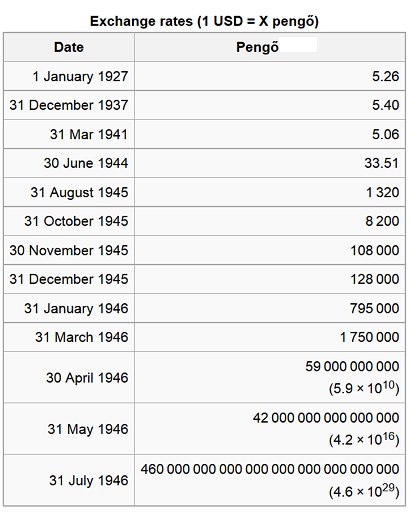
Let's compare this to what happened in Hungary.  In 1941, its currency (the pengÅ‘) was worth approximately $0.19 USD.  By June of 1944 it was worth about $0.03 USD.  That means that it took over 6 times as many pengÅ‘s in 1944 to purchase the same amount of goods that could be purchased in 1941.  That's not good but, as shown in the chart below, it got infinitely worse: 


Yep.  You're reading the chart correctly.  On July 31, 1946, $1 USD was equivalent to approximately 460,000,000,000,000,000,000,000,000,000 pengÅ‘s!  The Hungarian currency was experiencing hyperinflation the likes of which the world had never seen before and has not seen since.  In response, the Hungarian government started printing out banknotes of higher and higher denominations. 

One Thousand PengÅ‘ Note:  Issued July of 1945

One Million Pengő Note: Issued February of 1946
One Billion Pengő Note: Issued May of 1946

As inflation continued to skyrocket, the Hungarian government created a new term -- the milpengő, equal to 1 million pengős -- and issued the following banknotes in quick succession:

Ten Thousand Milpengő Note: Issued May of 1946
Ten Million Milpengő Note: Issued June of 1946
One Billion Milpengő Note: Issued June of 1946
Let's take a moment to examine that last banknote.  One billion milpengÅ‘s is equal to one billion million pengÅ‘s or 1 x 10¹⁵ pengÅ‘s.  At the time it was issued, $1 USD was trading for 4.2 x 10¹⁶ pengÅ‘s, meaning that it still required 42 of these notes to equal $1 USD!  

Sadly for the Hungarian people, the devaluation of the pengÅ‘ continued at an even faster pace, resulting in another new term: the b.-pengÅ‘ (pronounced bilpengo).  Now, you might think that a b.-pengÅ‘ was equal to a billion pengÅ‘s, but you'd be wrong.  It's actually equal to a trillion (1 x 10¹²) pengÅ‘s!  And so it was that in July of 1946 -- within the span of a single week -- the Hungarian Treasury responded to this crushing inflation rate by cranking out its final pengÅ‘ banknotes:

One Million B.-Pengő Note
One Hundred Million B.-Pengő Note
One Billion B.-Pengő Note
That last banknote is the highest denomination note that mankind has ever printed, equal to a billion trillion (1 x 10²¹) pengÅ‘s.  Since $1 USD was trading for approximately 4.6 x 1029 pengÅ‘s at that time, it required 4.6 x 10⁸ or 460 million of these notes to equal $1 USD!  

There is an ironic footnote to this story.  The one billion b.-pengÅ‘ banknote was printed but never issued to the public.  As a result, it has become a collector's item of sorts for numismatists.  It was worth only $0.000000002 when it was printed, but it's now auctioned on eBay for over $500!

 Now that would make a fascinating Economics class!

Sweeping up worthless pengő banknotes

Postscript

In August of 1946, a new regime was installed in Hungary. A new currency, the forint, was introduced and backed by the return of Hungary's gold supply which had been taken by the Nazis during the war.  Hungary's infrastructure -- in particular, its railroads -- were restored and its economy returned quickly to its pre-war level. 

Thursday, September 3, 2015

"Give me your huddled masses ..."


If the citizens of the United States were asked to vote on two symbols that best defined the nation, here's what would happen:
  1. Voter turnout would be about 40%.  That's America.  That's how we roll.
  2. The American Flag would get the most votes.
  3. The Statue of Liberty would get the second most votes.
I think it's safe to say that most Americans consider the Statue of Liberty a defining national symbol.  We are "Lady Liberty" with torch uplifted, welcoming immigrants to a new life and proclaiming, "Give me your tired, your poor, your huddled masses yearning to breathe free".   

But how can you reconcile this with the current national rhetoric surrounding Mexican immigration?  Rather than finding ways to help these huddled masses breathe free, many politicians (pandering to their constituents) are calling for higher walls, the repeal of the 14th amendment, more secure borders, deportation, drone surveillance, and no path to citizenship.  Rather than welcoming immigrants, they're actively denouncing them, wildly proclaiming that "they’re bringing drugs, they’re bringing crime, they’re rapists."  

What has happened to America?  What caused us to change?  Where are those ideals that our Founding Fathers and The Greatest Generation held so dear?

I'm kidding, of course.  Nothing has happened to America.  We're the same as we've always been.  Since the arrival of the Pilgrims on the Mayflower in 1620, virtually every nationality or ethnic group arriving in America has had to endure years of racism and discrimination before being grudgingly assimilated into American society.  Although the U.S. is often referred to as "The Melting Pot" the melting point is often very high and difficult to attain.  While virtually any nationality can be used as an example of this difficulty, let's take a look at what we did to the Chinese. 

Why the Chinese Emigrated to the U.S. 

The first Chinese began trickling into the U.S. around 1820.  Their immigration rate was so low, though, that only about 450 Chinese were living in the entire country in 1850.  Over the next 30 years that number would increase rapidly, driven in large part by the following events:
French political cartoon
The Opium Wars:  The two Opium Wars were conflicts between China and Great Britain over the Qing dynasty's attempt to suppress the opium trade.  Because of the ease in which the British defeated a much larger Chinese army, the end of the First Opium War (1839-1842) is referred to by Chinese historians as the beginning of the "Century of Humiliation".  The Second Opium War (1856-1860) was an even more devastating defeat for the Qing dynasty.  The resulting treaty legalized the opium trade, allowed foreign vessels to navigate freely on the Yangtze River, and allowed foreigners to travel to the internal regions of China.  Even more significant, it allowed British ships to carry indentured Chinese to the Americas.

The Taiping Rebellion
:  The humiliation of the Qing dynasty gave rise in 1851 to a highly nationalistic opposition force in China known as the "Taiping Heavenly Kingdom".  It was led by a charismatic visionary named Hong Xiuquan who believed that he was the younger brother of Jesus and had a duty to spread Christianity and overthrow the Qing dynasty.  This rebellion eventually expanded into a full-scale civil war which, by the time it ended in 1864, resulted in the death of between 20-30 million Chinese.  Thousands more fled the country to escape the intense poverty, sickness and social upheaval. 
Crop Failure of 1852:   A series of floods and crop failures ravaged southern China in 1852, leading to poverty and famine among peasant farmers.  As a result, over 20,000 Chinese emigrated from China to San Francisco in that year alone. 
The California Gold Rush:  To a Chinese peasant of the 1850's, life in China was simply abysmal.  Poverty and sickness were rampant.  Flood and crop failure were causing famine.  The Taiping Rebellion was bringing death and destruction.  The Qing dynasty was unraveling.  Imagine, then, hearing about a "Mountain of Gold" in the west coast of the United States, a destination that (while far away and expensive) was within their reach.  The period known as the California Gold Rush lasted from 1848 to 1855 and would entice many Chinese to make this trip.  By 1870, Chinese immigrants would account for over a quarter of all U.S. miners. 
The First Transcontinental Railroad:  As the Gold Rush subsided, a new source of labor continued to attract Chinese immigrants to California. Between 1863 and 1869 a 1,907-mile railroad line was constructed to connect the west coast at San Francisco with an existing eastern rail network in Iowa.  It is estimated that between 12,000 and 14,000 Chinese immigrants (about two-thirds of the entire work force) were used to provide the cheap manual labor that was needed.
As a result of these and other factors, the number of Chinese immigrants in the U.S. increased to approximately 25,000 in 1852 and to 300,000 by 1880.


Arrival, Acceptance and Discrimination
NY to California was
not easy in 1848!

By all accounts, the first Chinese to arrive in California in response to the Gold Rush were welcomed with open arms.  The reason?  California's non-native population in 1848 was about 1,000 and workers of any kind were in very short supply.  Moreover, until the Panama Canal was built 66 years later, it was actually quicker to get to California from China than it was to get to California from the eastern United States.  As such, Chinese immigrants were among the first workers to arrive. They were regarded as extremely industrious laborers who were happy to do menial tasks that others would avoid.  In the words of historian Henry Kittredge Norton:
"The result was that the Chinaman was welcomed; he was considered quite indispensable. He was in demand as a laborer, as a carpenter, as a cook; the restaurants which he established were well patronized; his agricultural endeavors in draining and tilling the rich tule lands were praised. Governor McDougal referred to him as “one of the most worthy of our newly adopted citizens.” In public functions he was given a place of honor, for the Californians of those days appreciated the touch of color which he gave to the life of the country. The Chinese took a prominent part in the parades in celebration of the admission of the state to the Union. The Alta California, a San Francisco newspaper, went so far as to say, “The China Boys will yet vote at the same polls, study at the same schools, and bow at the same altar as our countrymen.” Their cleanliness, unobtrusiveness and industry were everywhere praised."
By 1850, though, approximately 300,000 gold seekers had descended upon California.  Competition for work became intense and the Chinese began to be viewed differently.  Again, per Henry Kittredge Norton:
"The Chinaman was welcomed as long as the surface gold was plentiful enough to make rich all who came. But that happy situation was not long to continue. Thousands of Americans came flocking in to the mines. Rich surface claims soon became exhausted. These newcomers did not find it so easy as their predecessors had done to amass large fortunes in a few days. California did not fulfil the promise of the golden tales that had been told of her. These gold-seekers were disappointed. In the bitterness of their disappointment they turned upon the men of other races who were working side by side with them and accused them of stealing their wealth. They boldly asserted that California’s gold belonged to them. The cry of “California for the Americans” was raised and taken up on all sides."

Since the Chinese were not allowed to vote, the California legislature -- and Governor John Bigler in particular -- sided with the anti-Chinese movement. Bigler believed that the Chinese could never assimilate into American society and urged the legislature to "check this tide of Asiatic immigration."  Some of the legislation enacted during this period include:
The Foreign Miners Tax:  When initially enacted in 1850, this legislation levied a tax of $20/month on all foreigners engaged in mining.  After a revolt, it was lowered to $3/month, which was still over half of what a Chinese worker earned.  This tax would steadily increase over the years until it was finally ruled unconstitutional in 1870.
People v. Hall:  In 1854, the California Supreme Court ruled that Chinese Americans and Chinese immigrants could not testify against a white citizen. This freed a white man who had been convicted and sentenced to death for the murder of a Chinese miner even though three Chinese witnesses had testified to the killing.  In essence, the ruling extended a provision in California's criminal code ("No black or mulatto person, or Indian, shall be allowed to give evidence in favor of, or against a white man.") to include anyone of the Mongoloid race. 
Anti-Coolie Act of 1862:  Also referred to as the Chinese Police Tax, this law levied a fee of $2.50 "on each person, male and female, of the Mongolian race, of the age of eighteen years and upwards" that was engaged in a non-agricultural profession.  To make sure that there was no mistake, the law was subtitled, "An Act to Protect Free White Labor Against Competition with Chinese Coolie Labor, and to Discourage The Immigration of the Chinese into the State of California".  
Cubic Air Ordinance:  This ordinance, enacted in San Francisco in 1870, was aimed directly at the lifestyle of Chinese immigrants.  It required "every house, room, or apartment used for lodging within the limits of San Francisco, except public prisons and hospitals, to contain 500 cubic feet for each person residing in the lodging". Violations were punishable by a fine up to $500 and 3 months in prison.
Page Act of 1875:  While supposedly written to prevent anyone from “China, Japan, or any Oriental country” from entering the country "for lewd and immoral purposes" it had the effect of preventing almost all Chinese women from entering the country. The law classified as "undesirable" any individual from Asia who was coming to America to be a forced laborer, any Asian woman who would engage in prostitution, and all people considered to be convicts in their own country.
Other California laws prevented the Chinese from owning real estate, marrying a white person, or attending public school. 

Chinese Exclusion Act

Intense pressure from anti-Chinese groups in California and elsewhere culminated in the enactment of the Chinese Exclusion Act, signed into federal law by President Chester A. Arthur on May 6, 1882.  To this day, it represents one of the most draconian restrictions on immigration in U.S. history and was focused entirely on a single ethnic group.  The major components of this law: 
Halted Chinese immigration for 10 years:  "Be it enacted, that from and after the expiration of ninety days next after the passage of this act, and until the expiration of ten years next after the passage of this act, the coming of Chinese laborers to the Untied States be, . . . suspended; and during such suspension it shall not be lawful for any Chinese laborer to come, or, having so come after the expiration of said ninety days, to remain within the United States."
Prevented Chinese currently in the U.S. from becoming citizens:  "No State court or court of the United States shall admit Chinese to citizenship; and all laws in conflict with this act are hereby repealed."
Deported Chinese found to have entered the U.S. illegally : "Any Chinese person found unlawfully within the United States shall be caused to be removed therefrom to the country from whence he came, by direction of the President of the United States."
Enacting this law in 1882 was a black mark on the nation, to be sure.  It would have been relegated to an historical footnote had it been quickly repealed or declared unconstitutional, but such was not the case.  On October 1, 1888, President Grover Cleveland exacerbated matters by signing the Scott Act into law.  It expanded on the Chinese Exclusion Act by prohibiting Chinese laborers who had temporarily left the U.S. from returning.  While the enactment of this law was wildly celebrated in California, it stranded an estimated 20,000 to 30,000 Chinese who had left the United States planning to return.  In 1889, the U.S. Supreme Court upheld the legality of the Scott Act (Chae Chan Ping v. United States).

In 1892, the Chinese Exclusion Act was renewed for another 10 years.  As this extension approached expiration, American labor organizations lobbied for yet another extension.  The San Francisco Building Trades Council  argued that the very presence of Chinese workers in the marketplace dragged down the living standards of white workers.  In 1902, the American Federation of Labor (AFL) under Samuel Gompers published a pamphlet with perhaps the longest title in the history of pamphlets: "Some Reasons for Chinese Exclusion -- Meat vs. Rice -- American Manhood against Asiatic Cooliesm -- Which Shall Survive?"  Here's an excerpt from it which pretty much establishes the tone:
Beginning with the most menial avocations they gradually invaded one industry after another until they not merely took the places of our girls as domestics and cooks, the laundry from the poorer of our white women, but the places of the men and boys, as boot and shoemakers, cigarmakers, bagmakers, miners, farm laborers, brickmakers, tailors, slippermakers, etc. In the ladies' furnishing line they have absolute control, displacing hundreds of our girls, who would otherwise find profitable employment. Whatever business or trade they enter is doomed for the white laborer, as competition is simply impossible. Not that the Chinese would not rather work for high wages than low, but in order to gain control he will work so cheaply as to bar all efforts of his competitor. But not only has the workingman gained this bitter experience, but the manufacturers and merchants have been equally the sufferers. The Chinese laborer will work cheaper for a Chinese employer than he will for a white man, as has been invariably proven, and, as a rule, he boards with his Chinese employer. The Chinese merchant or manufacturer will undersell his white confrere, and if uninterrupted will finally gain possession of the entire field. Such is the history of the race wherever they have come in contact with other peoples. None can withstand their silent and irresistible flow, and their millions already populate and command the labor and the trade of the islands and nations of the Pacific.
As a result of this national propaganda campaign, the Chinese Exclusion Act was not only renewed again in 1902, it was made permanent!  In fact, this blot on our national conscious remained in force until it was repealed by the Magnuson Act in 1943, two years after China became our ally in World War II.  But the Magnuson Act was only a small step forward.  It allowed only 105 Chinese immigrants per year and continued to deny property rights to Chinese Americans.  It was only until the passing of the Immigration and Nationality Act in 1965 that a reasonable amount of Chinese immigration was granted. 
Illustration within the 1902 AFL pamphlet

In Closing ...

It may be hard to tell, but the point of this post was to actually cheer you up a bit.  As bad as the anti-Mexican immigration rhetoric is now, it pales in comparison to what was said and done to the Chinese 150 years ago.  It may also be heartening to know that back then -- like now -- there were people of reason and influence who saw through the hate and fear and tried to combat Chinese discrimination.  One such person was Mark Twain.  You might have heard of him.  Click here and read his thoughts on "the Chinaman" from his 1872 book called "Roughing It".  

Monday, July 27, 2015

Rube Goldberg lives!


Although I worked in IT-related jobs for my entire professional life, no one would ever call me a computer geek.  I know a little bit about a lot of different aspects of computers, but I'm not really a master of any of them.  That being said, this post will be just a tad geeky. 

It all started with a fantastic 60th birthday present that I got from Marilynn and the kids: a brand new top-of-the-line HP Spectre x360 laptop.  This thing is loaded, equipped with an Intel i7 dual processor, 8GB of memory, a 256GB Solid State Drive, three USB 3.0 ports, an HDMI port, a touch screen, and a 360 degree hinge that allows it to be used like a tablet.  Absolutely sweet!  PC Magazine agreed, giving it a 4 star "Excellent" rating in their March issue and naming it  "Editors' Choice: midrange convertible-hybrid laptop".   
The Spectre x360... in tablet mode!

I've been playing around with it for about three weeks now, and it's absolutely fantastic ... except for one teeny, tiny, itsy bitsy thing. Besides using it as a laptop and a tablet, I need to be able to use it as a standard desktop as well.  That means hooking it up to a scanner, an external hard drive and, most importantly, a large screen monitor.  Doing all of this was fairly easy, but it caused an unexpected and disastrous anomaly: my WiFi speed plummeted.  In particular, download speed dropped from over 75Mbps to under 2Mbps.  I kid you not. 


As a hack programmer, I've always enjoyed debugging my code.  I know that sounds weird, but I find it fun and oddly satisfying to locate my stupid mistakes and methodically correct them.  That's basically the technique I went through to attack this problem. 

I started with the anti-virus software.  I've been a Norton or McAfee man my entire life, so I was immediately suspicious of the Kaspersky anti-virus software that came with the Spectre.  All of the settings, though, looked fine.  Even completely disabling the software had no effect on WiFi performance.

I then reviewed all of the software that I had recently installed, particularly the freeware.  It was all from reputable organizations, but I uninstalled most of them anyway.  Once again, though, WiFi performance did not improve.

I then turned my attention to the ancient Epson scanner that I had just attached.  The installation had been a little bumpy, requiring a new driver.  I couldn't find a Windows 8.1 driver on the Epson website, so I grabbed the closest one they had:  a 64-bit Windows 7 driver.  The scanner worked fine but I decided to uninstall the applications and detach the scanner.  WiFi performance remained dismal.  

It was now way past lunch time and I needed a break.  Preparing to go downstairs, I disconnected the laptop from the large screen display and, instantaneously, WiFi response rocketed back to the 75Mbps level!  Somehow, using the HDMI port was interfering with WiFi communication!  It didn't make much sense, but at least I had something to google.

During lunch -- and in the space of about 15 minutes -- I found a whole host of possible solutions to my problem.  Some of them were absurd (reinstall Windows) but I found three solutions that seemed worth trying.  

Solution #1:  Change the WiFi Channel used by your wireless router.
Apparently, it's possible for the ambient HDMI signal leaking out of the cable to interfere with the WiFi signal.  Changing the channel, I was advised, might provide some relief.  After spending 15 minutes remembering how to connect to my router, I began by changing the channel from "Auto" to channel 1.  WiFi performance remained horrible.  I then changed it to channel 6 and performance improved a bit.  I then changed it to 11 ("these go to 11") and performance got even better, but still nowhere near where it should be.

I was willing to try anything!
Solution #2:  Wrap the HDMI cord in aluminum foil.  
I know you're thinking about the aluminum foil hats in "Signs" by M. Night Shyamalan, but this suggestion actually seemed to have merit.  I was using a fairly inexpensive HDMI cable and it's entirely possible that its shielding material wasn't the best.  Wrapping the cable wasn't a permanent solution, but it could point to the need for a better cable.  I gave it a try and performance did improve a bit more, but not enough.  

Solution #3:  Don't close your laptop lid.
I laughed out loud when I first saw this solution.  How could this possibly have any bearing on the problem?  Then I read other solutions that said the same thing.  No one provided a reason for why this might solve the problem, but I decided to give it a shot anyway. Amazingly, it worked!  WiFi performance zoomed back to the 75Mbps level!  But I didn't want my laptop wide open while I was using my large screen display so, as shown below, I used a pen to prop open the lid about an inch.  This seems to have done the trick.

Rube would be proud
Postscript: 
In a few days, I should have a more aesthetically pleasing solution in place.  Although the Spectre x360 is loaded, it doesn't come with an Ethernet port.  So I purchased a USB-to-Ethernet adapter from Amazon for about $20.  Ambient HDMI waves will continue to bombard me while I'm in desktop mode, but I won't be using WiFi.  So it should all be good.

Postscript to the Postscript:
Amazon delivery was faster than I thought.  The Startech.com USB-to-Ethernet Adapter arrived late this afternoon.  It took about 2 minutes to install.  As soon as I plugged an Ethernet cable into it, the Spectre automatically switched to it from WiFi.  I then ran Speedtest three different times with the laptop closed and got the following results:


Yep, you're reading that right.  My download speed is now averaging about 126Mbps.  Excuse me for a moment while I consult a thesaurus.  I need a word stronger than "sweet".....
This laptop is now officially stupefying!

Sunday, June 7, 2015

The Worst Song on the Radio Now: Volumes 2 and 3


Volume 1 of this series was published way back in November of 2012 and it's astonishing that an additional five or six volumes haven't already been published.  There are so many bad songs on the radio!  Somehow, though, no song ever seemed to sink quite as low as Die Young by Ke$ha, so I held back.  That was a mistake. Not every bad song needs to be the "LeBron James" of bad songs in order to be honored.  Here are a couple of songs in the "Carmelo Anthony" class.

Volume 2:   Honey I'm Good

Andy Grammar
It usually takes a few listenings before a song starts to bug me, but this one did it on the first try.  Maybe it's because it reminds me of these two all-time horrible songs:

   Thank God I'm a Country Boy by John Denver
   Cotton-Eye Joe by Rednex
 
And then there's the lyrics. At first, I thought, OK, not so bad.  It's a song about a guy staying true to his "baby at home" despite being tempted by the women at the bar.  I still disliked it, but it was palatable fluff. The third or fourth time I heard it though, the lyrics started sounding darker and creepier:

 "I could have another but I probably should not."

The guy doesn't say he won't have another; he says "I probably should not" which means (as anyone who's ever had a few beers knows) that he will have another!  While it's not clear how many drinks this guy has had already, it must have been quite a few:

"It’s been a long night here, and a long night there."

What is clear, though, is that he hasn't been thinking platonic thoughts ...

"And these long, long legs are damn near everywhere!"

... and his thoughts appear to be getting worse:

"And you’ve got that ass, but..."

It's at this point that he straightens up and tells the woman, "You've got me all wrong, baby".  Somehow, though, I doubt very strongly that she has him all wrong.  He's already started to rationalize his position:

"Better men than me have failed, drinking from that unholy grail."

How it eventually will end
In essence, then, here's the picture being painted by this song:  A guy is drinking for hours at a bar while the woman that has "all of his love" is back at home.  Sounds a little dodgy, but, hey, it sometimes happens.  But this guy isn't at a sports bar with the boys watching the big game.  He's drinking heavily at what sounds like a singles bar and checking out the girls, to the point where he compliments the ass of the woman he's talking to!  Suddenly, he snaps to his senses and realizes that if he has just one more drink, "I might not leave alone."

Somebody better have a long talk with his baby at home.  Despite the bouncy music and cutesy refrain, this song is talking about a relationship that is one jack and coke away from disintegration.


Volume 3:  Go Big Or Go Home

American Authors
If you haven't heard this song yet, don't worry.  You will.  It was only released a couple of months ago and hasn't made it into the Billboard Hot 100 yet, but trust me, it'll be there before the month is out.  This band is a case study on how to make it big in the music world today.

They originally formed in 2006 under the name "Blue Pages" and labored in relative obscurity for 5 years, putting out mediocre pop songs such as Run Back Home.  In 2012, though, they went through a complete overhaul, emerging with a new patriotic name, a new market-focus sound (see the "Teen Girl Pop" formula described in Volume 1 of this series) and a smash hit called Best Day of My Life.  It opens with a rudimentary banjo riff (an attempt to attract the Mumford & Sons crowd?) and is simply loaded with repeated syllable hooks to the point of being laughable:
"Oo-oo-oo"
"Wo-o-o-o-o-oh" [x2]
"My li-i-i-ife"
This song is bad, but it isn't quite worthy of the coveted Worst Song on Radio Now award.  Go Big Or Go Home, though, is a tour de force of horribleness. 

It begins with the title.  The phrase "go big or go home" is a marketing slogan from the 1990's that turned into a hackneyed sports cliche years ago.  The fact that American Authors are latching onto it now tells you all you need to know about this band.  

Next, as dictated by the "Teen Girl Pop" formula, the song contains a mandatory repeated syllable hook, in this case, "Go big or go ho-o-o-o-o-me".  It's annoying, to be sure, but it's not enough.  What vaults this song into Worst status is the continuous stream of party-all-night-binge-drinking-live-for-the-moment lyrics that Ke$ha would be proud of.  For starters, there's this:
Giving my body all the things I need
Rescue me with a little whiskey
Staying out, don't need no sleep
I'll sleep when I'm dead; you can bury me
And then there's this:
I guess I'm going home
Cause all my cash is gone
I spent it all trying to feel alive
And finally, this:
Yeah, I got nothing to do tonight
I'm passed out on the floor
Up in the hotel bar
But it don't matter, cause I'm feeling fine
I'm thinking life's too short; it's passing by
So if I'm gonna go at all
Go big or go home
The message of this song is clear:  Life is too short.  You can't let it pass you by.  You need to "go big", and the best way to "go big" is to stay out all night, spend all of your money drinking whiskey until you pass out, and then get up and do it again and again.  And you can do this because you "don't need no sleep" which, as a double negative, is the only helpful (albeit unintentional) advice in the entire song.
Thanks, John...

Pretty crappy song, right?  Who in their right mind would want this to be their theme song?   The National Basketball Association, that's who!! For the last few months it has been featured in their NBA Playoff Promotions videos.  I wonder if John Abbamondi, Senior Vice President of Marketing for the NBA, listened to the lyrics of this song even once?