Tuesday, June 11, 2013

Tour de Cure 2013

Just happy to see the sun!
After a year's hiatus, Marilynn and I returned on Sunday, June 9th, to ride with Team BMS in the Princeton Tour de Cure, a fund-raising event that benefits the American Diabetes Association.  In 2011, Team BMS was somewhat of a fledgling group.  That year, our team photo consisted of only 13 riders, but we still managed to raise about $18,000.  Not bad at all, but what a difference a couple of years makes!  Under the guidance of Laura Shemanski, Team BMS has grown to over 100 riders.  At last count, we raised almost $64,000 for the ADA this weekend!   Quite a testament to Laura's organizational and managerial skills and the generosity of the BMS family!

All revved up with 64 miles to go
I've participated in this event since the mid-90's and, as I've said many a time, there are five key elements to a successful ride (in order of importance):
  1. No one falls and no one gets hurt (other than sore muscles)
  2. No flats, broken spokes or other bike problems
  3. Good riding weather ... not brutally hot and no rain!
  4. No one "bonks"
  5. No one gets lost
For the most part, we batted 5-for-5 on this Tour.  Well, Marilynn jammed her chain twice on two particularly nasty hills (causing her to topple over once), and my back tire somehow released itself and damn near fell off at around mile 60, but those were extremely minor difficulties. 

The weather was absolutely perfect -- a major miracle considering the monsoon-like conditions that New Jersey experienced before and after the ride.  It couldn't have been a more pleasant day:  the sun was shining, the roads were dry, and the temperature was in the low 80's for most of the ride. What more could a biker ask for?

Bonking wasn't a problem either, thanks to four well-stocked rest stops.  The photo below gives you an idea of what each of these stops looked like: 

Everything except an ice cold beer
The first rest stop also featured an emergency bicycle repair tent manned by Hart's Cyclery of Pennington, a very nice touch.  And at the last rest stop, we had a chance to meet "Buddy" (see below).  I'm not sure what kind of dog Buddy was (Terrier?), but I heard his owner say that he was 13 years old and had diabetes!  Whether or not that was true, there's no lying that Buddy was very cute and friendly.  And I was also told how to properly pronounce his name.

"Hey Buuuddy"
Marilynn and I stopped at every rest stop, even if we weren't particularly tired or hungry.  To ride by one without stopping would have been bad karma.  You never pass up a port-a-john opportunity.  Never.  By the way, unlike prior Tours, there were 2 port-a-johns at every rest stop, even at the first one (which all bikers know is crucial). 

Always a sight for sore eyes ...
The route was publicized well ahead of time and made available electronically via MapMyRide.  Below is a screen capture of our ride:

At least we didn't have to climb Poor Farm Road!
There are a couple of things worth noting about the route. 
  1. Mile 42:  At this point, we hit one of the best downhills of the entire ride.  Me and two other guys flew down it, braking only minimally.  As we hit our peak speed at the bottom I heard one guy yell, "We just missed a turn!"  Yep.  It was at that point (and at only that point) that the designers of the tour decided that directional guidance was not needed.  There was no painted red arrow on the road or orange traffic cone at the corner telling us to take a left onto Garboski Road.  Thankfully, one of the guys I was riding with was also on the route committee, but he had no explanation for the lack of signage.  In retrospect, though, it was just as well.  It was a hell of a lot of fun blasting down that hill!
  2. Mile 50:  It was at this point, after almost 4 hours on the bike, that the Tour headed into the Sourland Mountains. Yep.  I kid you not.  Check out the change in elevation on that map.  Marilynn knew it was coming though, and dug deep.  A real trooper. 
Other than the Garboski Glitch, the route was exceptionally well-marked.  And even if we had gotten lost, each of us had a cue sheet and an emergency phone number to call for help.   

By the time we returned to ETS, both Marilynn and I were more than happy to get off of our bikes.  Five hours on a bike is a long, long time.  Our legs were stiff, but other parts of our anatomy were in much worse shape.  It was tons of fun though, and we're looking forward to doing it again next year!

Happy to be off the bike!


A small subset of Team BMS!

RPM has arrived!!


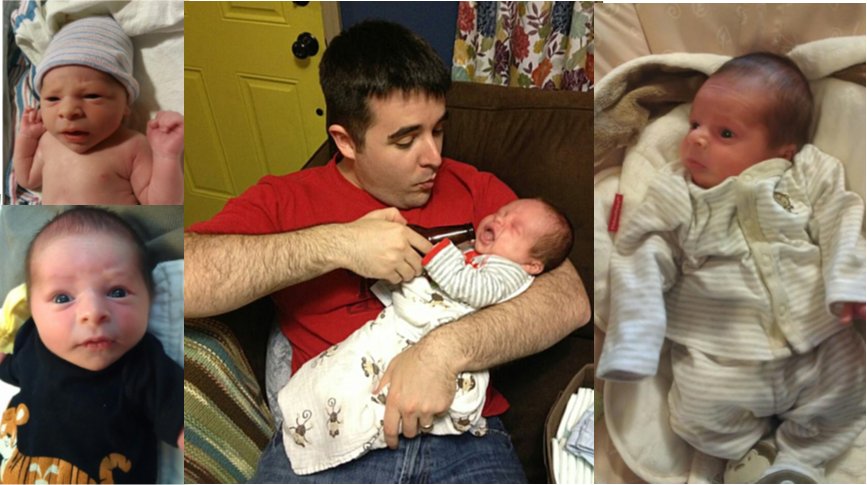
Reece Patrick Mullen was born on Friday, April 12, 2013, at 4:04am to Jonathan and Lacee Mullen.  Little Reece was 5 pounds and 18" long at birth but, as you can see from the photos below, he has grown fast!


Congratulations to Jonathan and Lacee and welcome, Reece, to the Mullen Family!


Friday, March 8, 2013

Tom Mullen: Athlete

February 3, 1954 – March 8, 1993
There are so many things that I could say about my brother, Tom, to mark the 20th anniversary of his tragic death at the hands of a drunken driver.  He was a brother, a father, a husband, a friend, a co-worker, and the undisputed leader of the family.  He had a tremendous intellect, a winning smile, and was respected and loved by all that knew him.   But you all know that.  What many of you might not know (or might not clearly remember) is that Tom was, in my opinion, the best athlete in the family. I know my sisters, Annie and Chris, might dispute this claim based on their participation in multiple varsity sports at Our Lady of Lourdes High School, but I’m sticking with Tom. Here’s why:

Speed: My memory is a bit hazy on this point, but I seem to recall that Tom was on the high school track team for a year or two. He couldn’t run for distance to save his life, but he had excellent 100-yard dash speed. I don't believe he ever clocked under 10 seconds, but he was damn fast. No way Dad could ever have caught him! 

Agility: Tom was the only family member with less flexibility than me, but he had very quick reflexes, great agility, and extraordinary hand-eye coordination. He and I played an unofficial “game” over the years where I’d throw something at him just as he was turning around – a spoon, a ball, an empty cup – whatever was handy. More often than not, Tom would catch whatever I threw without even thinking about it. To this day, whenever I drop something but manage to reach down and catch it before it hits the ground, I think of Tom.

Overall Body Strength: Inspired by his cousin, Steve Lucas, Tom started lifting weights at a fairly early age, possibly as early as 8th grade and definitely by the time he was a freshman in high school. Showing an early astuteness for Finance, he somehow got me to contribute to the purchase of a Joe Weider Weightlifting Set consisting of a bench, a barbell, a couple of dumbbells, and 110 pounds of weights. Lord knows why I contributed to this scam ... I hadn’t even hit puberty yet!  I rarely used it.  Tom did though, and rapidly outgrew it.  A couple of years later he was lifting at the Poughkeepsie YMCA and, eventually, at AllSport, a nearby fitness facility. For about 4 or 5 years, Tom was a dedicated bodybuilder, reading magazines like "Muscle & Fitness" and "Iron Man", and drinking “power shakes” laced with Crash Weight protein powder. He ended up with a strong, chiseled body which he used to great advantage in all of the sports that he played. 

Baseball:  In Little League, your best and most athletic players are pitchers, catchers, or first basemen.  Your worst players are right fielders.  That's just the way it is.  Tom and I both played in Little League for a team called Western Printing.  The coach (Sam Forman) took one look at Tom and made him a pitcher.  I was told to grab my mitt and head out to right field.  For the first year or so, Tom was a great pitcher.  He could throw the ball with decent speed and was very accurate.  He hardly walked anyone.  And that was great, until the kids started getting a little bit bigger and a little bit better.  And so, on one sunny day at Spratt Park in Poughkeepsie, it became clear that Tom's pitching days were at an end.  He threw one of his trademark belt-high, plate-splitting fastballs to Scottie Coleman, who promptly hit it over the fence and across Wilbur Boulevard, pound for pound the longest home run I have ever seen.  Tom's career didn't end that day, but I don't remember him playing baseball again after Little League.


Football: Tom’s athletic skills were best showcased on the football field as a running back. In grade school he played halfback for the Cardinals, a team in the Poughkeepsie Pop Warner Football League. I don’t remember Tom's statistics, but I do remember that his picture and name were in the Poughkeepsie Journal sports section almost every week! He ended up winning the league’s Most Valuable Player when he was in 8th grade. When I came along a year later, the coaches of the Cardinals chose me to play for their team.  I think they expected Tom's brother to have the same level of athleticism that he did. Sorry guys ... at 4’10” and 90 pounds, I was no Tom Mullen!  Tom continued to excel in football at the high school level.  By this time, he was 5’11” and close to 200 pounds of muscle, so he was moved to fullback. Lourdes won the Dutchess County Scholastic League championship his senior year, and Tom had a very good season as the starting fullback. Tom was proud of both his team and his own abilities. During that senior season, I remember him telling me, half joking, but half serious as well, “Nobody stops me inside the 5!” That remark would come back to haunt him in the Sectional playoffs that year when they lost a very close game to an undefeated team from Yorktown. Near the end of the game, Tom was stopped at the goal line on a 4th down run up the middle . Years later, when the two of us were having a few beers together, I casually worked his quote and that play into the conversation.  We had a good laugh.

After high school, I seem to recall Tom thinking about playing on the Marist College club football team but hurting his knee before the school year actually began. There’s no record of Tom being on the Marist roster back then and no one else in the family recalls Tom spending even part of a semester at Marist, so I could be wrong. At any rate, other than the occasional Turkey Bowl on Thanksgiving, Tom never played organized football of any kind after high school.

Basketball: Tom was not a natural basketball player. His primary sport was football, so he had to bulk himself up so that he could absorb the pounding that his body would be taking. By doing this, though, he turned himself into what would now be called a small “power forward”.  He wasn’t a great ball handler and we laughed about his inability to make a driving layup, but he had a deadly medium range jump shot. Even more important, he was a force underneath. He rebounded extremely well and enjoyed nothing better than tipping in a teammate’s missed shot. To this day, whenever I manage to get a tip-in, I think of Tom. Tom probably would have started on the high school varsity basketball team when I was a senior, but he had no chance of even playing on the team when he was a senior. His class had one of the best basketball teams in Lourdes history. Instead, Tom played in the CYO and Church basketball leagues. One of the best decisions I ever made in my life was to play with him on those teams during my Junior year rather than play on the high school team.  It was the most fun I’ve ever had playing basketball to this day. Tom was our team leader that year – scoring, rebounding, setting picks, and doing whatever was necessary to win. Surprisingly, though, my clearest memory of Tom that year involves a game that we lost. In the Church League championship game, we found ourselves down by two points with only seconds to play. I was at the line shooting a foul shot and was instructed by the coach to intentionally miss so that we could try and tie the game on the rebound. I did my part (I was good at missing foul shots) and, after a scramble, the ball bounced right to Gabe Welch (a teammate) about two feet from the basket. Somehow, Gabe missed the shot and we lost.  While the other team ran off the floor hooting and hollering, Gabe just stood there with his head down, the picture of abject despair. I felt bad for Gabe but had no idea what to say to him. Tom did. Well aware of Gabe’s penchant for theatrics, he walked by him and casually muttered, “Cut the crap, Gabe”. Gabe looked up with a big smile and said, “OK!”

Tom and I played basketball together all the time at the Poughkeepsie YMCA and had a very high winning percentage against the “hatchet men” as we called them. We made a good team. I took care of the dribbling and the outside game, and Tom handled everything underneath. And we were both fast! I only wish I could remember more details about those games. 

Tom remained in good shape throughout college. He and I would lift or play basketball together whenever we could during the summer months. In the mid-80’s though, he cut back on his exercising and became stiffer and stiffer. After a while, it seemed like he pulled a muscle whenever we tried to play basketball. He finally stopped playing basketball altogether in his early thirties.  However, a few weeks before his death, Tom told me that he was going to embark on one of his famous “Programs”. He was going to concentrate on nothing but stretching and flexibility. “You watch … I’m going to become a rubber man!” I believed him. He was 39 and I was 37, and I couldn't wait to play basketball with him again. 

Tom Mullen, age 17

Monday, January 21, 2013

Repeal the Second Amendment

I never considered myself a flaming liberal with, as the NRA likes to say, a “gun grabbing agenda”.  I'm not a hunter and I don't own a gun, but I've always supported those that did want to own a gun for hunting, target practice, or simple self defense.  After all, this is America, land of the free!  The right of a citizen to own a gun is as American as Mom and apple pie, right?

After the Newtown tragedy, I decided to take a long and careful look at this "God-given right" and came to a surprising but unavoidable conclusion:  the Second Amendment must be repealed. See if you agree.

A Brief History:

The Second Amendment consists of only 27 words, yet millions of words have been spoken and written about it.  Here it is in all of its majesty:
“A well regulated Militia, being necessary to the security of a free State, the right of the people to keep and bear Arms, shall not be infringed.”
Most constitutional scholars agree that the Second Amendment was added to the Bill of Rights to reassure the States that their militias would not be eliminated.  At the time, the States viewed militias as being “checks” on the standing army should the central government turn tyrannical.  There is also evidence that slave States feared the elimination of their “slave patrol” militias which helped to regulate and enforce the slave trade.

Slavery was abolished in 1865, never to return.  The ability of State militias to act as “checks” on the combined power of the U.S. Military ended well over a century ago.  State militias no longer exist!  As such, the Second Amendment should be regarded as nothing more than a quaint anachronism, similar to the Third Amendment which prohibits the quartering of soldiers in private homes without the owner’s consent. Unfortunately, that isn't the case. 

Many historians consider the Second Amendment, authored by James Madison, to be one of the poorest written sentences in the entire Constitution.  Yale law professor Sanford Levinson refers to it as “The Embarrassing Second Amendment”.   Constitutional scholars debate over the meaning of almost every one of its 27 words.  The pivotal debate, though, is whether this amendment applies unconditionally to all citizens at all times or only to those citizens serving in “a well regulated Militia”?  

In the past, the Legislative Branch of the government tap-danced around this debate, enacting firearm legislation that blithely violated the “shall not be infringed” clause, relying on the Judicial Branch to rule (when needed) that the Second Amendment applies only to activities involving “a well regulated Militia”.   

This proved to be a successful strategy in the case of The National Firearms Act of 1934, which defined various categories of firearms and severely restricted the purchase and ownership of Title II weapons (machine guns, short-barreled shotguns, bombs, grenades, missiles, poison gas, etc.).  In United States v. Miller (1939), the Supreme Court rejected a claim that this act violated the Second Amendment right to own a short-barrel shotgun, stating:
"In the absence of any evidence tending to show that possession or use of a [short-barrel shotgun] at this time has some reasonable relationship to the preservation or efficiency of a well regulated militia, we cannot say that the Second Amendment guarantees the right to keep and bear such an instrument."
The Gun Control Act of 1968 built on that court decision by regulating the firearms industry even more, prohibiting interstate firearms transfers except among licensed manufacturers, dealers and importers.

However, the government's gun control strategy disintegrated in 2008 by a challenge to the District of Columbia’s Firearms Control Regulation Act of 1975 which banned residents from owning handguns, automatic firearms, or high-capacity semi-automatic firearms.  In District of Columbia v. Heller, the Supreme Court ruled, by a margin of 5-4, that:
“The Second Amendment protects an individual right to possess a firearm unconnected with service in a militia, and to use that arm for traditionally lawful purposes, such as self-defense within the home.”

“The Amendment’s prefatory clause announces a purpose, but does not limit or expand the scope of the second part.”

“The District’s total ban on handgun possession in the home amounts to a prohibition on an entire class of ‘arms’ that Americans overwhelmingly choose for the lawful purpose of self-defense.”
Game over.

Under this interpretation, all hope of enacting meaningful gun control legislation in the United States vanished.  Effectively, the Second Amendment now reads:
“The right of the people to keep and bear Arms shall not be infringed.”

Moving Forward:  Step 1

President Obama recently announced a series of initiatives designed to reduce gun violence in the United States.  They include

  -  Requiring criminal background checks for all gun sales
  -  Banning assault weapons
  -  Limiting magazine capacity to 10 rounds
  -  Banning armor piercing bullets

Although a majority of Americans support these initiatives, turning them into actual legislation will be an enormous challenge, one that is probably beyond the ability of our current Congress.  But even if  Democrats and Republicans set aside their differences and enacted a truly elegant piece of gun control legislation, it would be a total waste of time.  A single U.S. citizen could negate their effort by simply challenging the new legislation in court.  Based on the legal precedent set in District of Columbia v. Heller, the new legislation would have to be declared unconstitutional.

As such, the absolute first step in the herculean task of meaningful gun control must be the repeal of the Second Amendment.  Otherwise, all other initiatives will only be exercises in futility.

Moving Forward:  Step 2

Once the Second Amendment has been repealed, what would be the next logical step to effectively reduce gun violence in the United States?  Would it be to implement the Obama initiatives outlined above?  Almost certainly not.

Improved criminal and mental background checks would not have prevented the Newtown tragedy since the guns used in the shooting were stolen.  A ban on assault weapons will not apply to many semi-automatic firearms that can easily inflict the level of damage done at Newtown.  Limiting magazine capacity to 10 rounds is unlikely to meaningfully reduce future casualties either.  As shown in this video, it takes an experienced gunman about one second to change a magazine.  The bottom line is that none of the Obama initiatives address the central issue surrounding gun-related homicides in the United States: easy access to simple handguns.  

As such, the next logical step forward is to educate the public on the impact that individual handgun ownership has on safety in the United States.  In that vein, here are some sobering statistics.


Ironically, this chart (created by data provided by the FBI) is currently being used by the NRA and other opponents of an assault weapons ban to show that simple handguns, not AR-15 assault rifles, are responsible for most murders in the U.S.  In this rare case, the NRA is absolutely correct.  Assault weapons should be banned, but they are only a small subset of a much larger problem.  What this chart clearly shows is that guns of all kinds (and handguns in particular) were responsible for 67.5% of all homicides in the U.S. in 2010.

A separate world-wide analysis, conducted by the United Nations Office on Drugs and Crime, is in line with the FBI data.  It reports that, in 2009, the U.S. had 15,399 homicides, 66.9% of which (10,300) were due to firearms.  This results in a firearm homicide rate per 100,000 people of 3.3.  In comparison, the United Kingdom had only 722 homicides with only 6.6% (46) due to firearms.  The U.K. firearm homicide rate per 100,000 people was a mere 0.07.  That's right.  After adjusting for population differences, the U.K. firearm homicide rate in 2009 was 47 times smaller than the U.S.firearm homicide rate!   If the U.S. had matched the U.K. results, the number of U.S. homicides in 2009 caused by firearms would have been only 232.  Over 10,000 lives would have been saved. 

But that's not all.  According to the Center for Disease Control, guns are the cause of over half of all suicides in the U.S.  According to GunPolicy.org, in 2009 there were 18,735 gun-related suicides in the U.S., a rate of 6.11 deaths per 100,000 people.  In the U.K. there were 101 gun-related suicides, a rate of 0.16 deaths per 100,000 people. If the U.S. had matched the U.K. results, the number of U.S. gun-related suicides in 2009 would have been only 490.  17,884 lives would have been saved. 

I think it's safe to say that the opportunity of saving almost 28,000 lives a year is a worthwhile goal.

Moving Forward:  Step 3

Tragically, it seems to take an incredibly horrific event like the massacre of innocent children before the magnitude of the gun violence problem is brought home to the public.  And in this case I'm not referring to the shooting in Newtown;  I'm referring to what happened in the United Kingdom almost 17 years ago.

On March 13, 1996, a 43-year old gunman entered a primary school in Dunblane, Scotland, armed with 4 handguns.  He shot and killed 16 children and 1 adult before committing suicide.  It was one of the deadliest criminal acts involving firearms in the history of the United Kingdom.  The ensuing public outcry resulted in the Firearms Act of 1997, which almost completely banned the private possession of handguns.   As a result of this and other Firearms legislation, the general public throughout the U.K. is now prohibited from owning:
  • An automatic weapon
  • A semi-automatic weapon greater than .22 caliber 
  • A "small firearm" (barrel length of less than 30 cm or an overall length of less than 60 cm)
  • Armor piercing ammunition
  • A firearm disguised as another item (e.g., a cane)
  • Rockets, mortars, and similar explosives
All other rifles and ammunition are permitted with "good reason", but that reason cannot be simply self-defense. 

Enacting gun control legislation such as this in the United States will not be easy;   indeed, it will be a long and arduous task.  But it must be attempted.  Otherwise, tens of thousands of Americans will continue to die each year from gun violence and the likelihood of another Newtown-like massacre will remain strong.

Wrapping It Up

For 217 years the Supreme Court held that the Second Amendment granted the right to bear arms only to  members of a "well regulated Militia".  However, 5 years ago, the Court (by a narrow 5-4 margin)  extended the scope of this amendment to include private citizens as well.  Until this travesty is corrected, the enactment of meaningful gun control legislation is impossible.

It is not acceptable to simply wait and hope that a future Supreme Court decision overrules the catastrophic decision reached in District of Columbia v. Heller.  The Second Amendment must be repealed.  It cannot be left to linger in the Constitution like a loaded musket, waiting to misfire in the wrong hands.  


Tuesday, November 13, 2012

The Worst Song on the Radio Now: Volume 1


I've always loved music.  I can still remember lying in bed in 1965 -- a ten year old with a small black transistor radio -- listening to WABC's Top 100 Songs of 1965.   But there have been two times in my life when I just couldn't listen to the music being played on popular radio: in the mid-to-late 70's during the disco craze, and in the mid 80's when bands like Boston, Styx, Rush, and Queen ruled the airwaves.
I'm not saying that either of these music genres were bad;  they just didn't interest me and pushed other music off the air.  Well, it's happened again.  A genre of music that I call "Teen Girl Pop" is now dominating commercial radio.  Songs in this genre contain at least one (but usually several) of the following characteristics:
  • Driving Drum Beat:  This music is meant to be played and listened to at clubs while dancing;
  • Banal Lyrics:  Partying, flirting, binge-drinking, breaking up, making up, living for the moment ... I think you get the picture.
  • Distorted Vocals:  A technique that makes the singer sound as though he or she is singing through a megaphone or a bullhorn. Think of The Strokes, only more so. 
  • Repeated Syllabic Lyrics:  Sure, this has been around since "talkin' 'bout my g-g-generation", but it's exploded since Lady GaGa's "p-p-p-poker face" .  A few wildly popular examples:  "Where have you been all my li-i-i-i-ife?", "the o-o-o-one, the o-o-o-one, the o-o-o-one, the one that got away", "kiss me, ki-ki-kiss me", and "as long as you la-la-la-la-love me, love me".
  • Dubstep Break:  Thankfully, these breaks are never long enough to cause nose bleeds, but just long enough to try and make the song sound hip.
  • Rap Interlude:  Nothing sounds as genuine as a rich 20-something white woman breaking into rap in mid-song. 
With that as background, here's a list of consecutive songs that were played on a popular New Jersey radio station last week while I was working out at my gym for one hour.  I've highlighted what, for me, is "The Worst Song On The Radio Now". 


If, somehow, you have yet to hear this song, click here.

So, besides being a song in a genre that I don't particularly like, what caused me to lose all objectivity and call this song -- not just a bad song -- but the worst song?

Style:  As with many of the songs listed above, it slavishly adheres to the "Teen Girl Pop" formula.  It has a driving guitar beat, the usual lyrics about drinking, dancing and partying, and a rap interlude.

Music:  Some songs in the "Teen Girl Pop" song actually contain interesting music which requires a real band with actual musical skills.  Not so here.  The music in this song can be easily replicated by a high school kid with a drum machine and a synthesizer.  

Lyrics:  This is where this song truly distinguishes itself.  Delivered with a poppy, catchy beat that you can't get out of your head, it contains lines like the following:
"It's pretty obvious that you've got a crush, that magic in your pants is making me blush."
"Oh what a shame that you came here with someone."
"Let's make the most of the night like we're going to die young."
And in case you're not getting the message, the refrain pounds it into you by repeating, "We're gonna die young."  In other words, live for today, have fun tonight with whomever you happen to be with because you might die tomorrow.  A wonderful philosophy for the "Teen Girl Pop" generation!  The amazing thing is that since this abysmal song is delivered without a single expletive, its lyrics are deemed safe for all ages.  Believe me, kids need to be protected from a song like this much more so than from a song like "Lose Yourself" by Eminem!

One more thing.  Ke$ha spells her name with a dollar sign.  That says all you need to know about the driving force behind this song and this artist.

Wednesday, November 7, 2012

Thank You Donald Trump!

"Constitution:  You're fired!"
The 2012 Presidential election was brutal.  The agony began with the Republican primary, which seemed to go on forever.  In case you've purged it from your brain, there were twenty debates, involving such eminent statesmen as Michele Bachman, Rick Perry, Herman Cain, Rick Santorum and Newt Gingrich.  This was followed up by three Presidential debates and one Vice-Presidential debate that were almost totally devoid of substance.  Flowing through all of this was a deluge of campaign ads fueled by the most amount of money ever spent on a Presidential election.  According to some sources, when combined with Super PAC money, the Obama and Romney campaigns spent approximately two billion dollars. 

It was also an incredibly divisive campaign that left the US electorate split right down the middle.  Up until the day of the election, the race was too close to call.   But finally, on the evening of November 6, it all came to an end.  Barack Obama was re-elected by a comfortable margin in the Electoral College but by a fairly narrow margin in the popular vote.  Democrats cheered while Republicans wept.  About an hour after the election had been decided, Mitt Romney gave a gracious, if short, concession speech saying in part:
"This is a time of great challenges for America, and I pray that the president will be successful in guiding our nation ... At a time like this, we can’t risk partisan bickering and political posturing.  Our leaders have to reach across the aisle to do the people’s work.  And we citizens also have to rise to the occasion" 
While these were excellent words, it was hardly enough to heal the wounds of a nation and unify two parties that had been at each others throats for four year.  The country was still polarized.  It needed something else, something stupendous, that everyone could rally around.  To paraphrase Otter from the movie Animal House: "This situation absolutely required a really futile and stupid gesture be done on somebody's part".  But who would be a stupid enough guy to do it?  Enter The Donald! 

Speaking via Twitter to his followers on Election night, Trump starts out under control -- diplomatic, and rational:

Well said Mr. Trump, well said.  Almost Churchillian.  As the early results favoring Mitt Romney rolled in, Trump continued to wax philosophic:


Suddenly, though, somewhere around 11pm when Ohio fell to Obama and it was clear that Romney had lost, The Donald delivered a terse announcement:


But if you thought that The Donald was going to stop right there and call it a night, well, you don't know Donald Trump.  In rapid succession, he fired off the following tweets to his faithful:


He also posted the following tweets, which he deleted once they were discovered by Brian Williams, anchor for NBC Nightly News, and read over the air:
"He lost the popular vote by a lot and won the election. We should have a revolution in this country!"
"The phoney electoral college made a laughing stock out of our nation. The loser one!"
"More votes equals a loss…revolution! "
At this point, one can only assume that The Donald had been liberally sipping on an especially potent vintage of Viognier from the world renowned Trump Winery ever since the polls had closed on the east coast.  In the space of a few minutes he did everything he could to invite the federal government to prosecute him and his followers under Section 2384 of the US Code which states:
"If two or more persons in any State or Territory, or in any place subject to the jurisdiction of the United States, conspire to overthrow, put down, or to destroy by force the Government of the United States, or to levy war against them, or to oppose by force the authority thereof, or by force to prevent, hinder, or delay the execution of any law of the United States, or by force to seize,take, or possess any property of the United States contrary to the authority thereof, they shall each be fined under this title or imprisoned not more than twenty years, or both."
So far, the federal government has wisely avoided prosecuting Trump.  Why?  Because he is performing an incalculable service to the nation!  Democrats and Republicans who had been fighting each other tooth and nail finally have something they can agree upon:  Donald Trump is a blithering idiot!!  True, it's an extremely small and insignificant place to start, but it's a start.  Thanks, Don.

Sunday, November 4, 2012

Say "Hello" to Logan Matthew Mullen!

Logan Matthew Mullen

Congratulations to Bridget Mullen on the birth of her son, Logan Matthew, on September 24, 2012.  Logan weighed in at 7 pounds, 4 ounces and  was 19.5 inches at birth.  Bridget wasted no time getting Logan into the swing of things, bringing him to a Family party at my house in Cranbury, NJ, on October 20th. 

Generation 9 of the Family Tree is starting to fill out nicely!  Welcome, Logan!


The Electoral College


As a result of Hurricane Sandy, the entire state of New Jersey postponed the celebration of Halloween until Monday, November 5th.  Once Halloween is safely behind us, though, we'll head to the polling booths for a truly scary event -- the election of the next President of the United States, the "leader of the free world"!   Why is it so scary?  For your consideration:  The Electoral College.

The Electoral College was created by Article 2, Section 1 of the U.S. Constitution and was refined in 1804 by the 12th Amendment.  Together, they describe the following method used in the United States to select our President and Vice President:
  • Each state is allowed to appoint a number of Electors that equals the number of its Senators (two per state) plus the number of its Representatives (depends upon the state's population).  As such, New Jersey has 14 Electors (2 + 12) while Wyoming only has 3 (2 + 1). 
  • Each candidate running for President has his or her own group of Electors in each state.  In most cases, these Electors are chosen by the candidate’s political party, but the exact selection process and responsibilities of Electors could vary from state to state.
  • For each state, the Electors representing the candidate that won the popular vote in their state meet on the first Monday after the second Wednesday in December after the presidential election to cast their votes for President and Vice President.  Technically, the next President of the United States won't officially be elected until the Electoral College cast their ballots on December 17, 2012. 
That's all there is to it.  Pretty simple, huh?  Not really.

To begin with, there are no Constitutional provisions or Federal laws describing how Electors are to be appointed or whether or not they must vote according to the results of their statewide popular vote.  While most states expect Electors to vote for the candidate that wins the statewide popular vote, only about half of the states actually require it.  Also, most states have a "winner take all" philosophy, whereby all Electoral votes go to the candidate that wins their statewide popular vote.  But two states (Maine and Nebraska) allow their Electoral votes to be divided among the candidates.  Other states are considering similar options.

Also, it is easily possible for a candidate to gain a majority of Electoral votes (and thus be elected President) while losing the popular vote.  That's exactly what happened in the 2000 election when Al Gore won the popular vote by 543,895 votes but George W. Bush won the Electoral College by a count of 271-266.  Indeed, as shown in the table below, it is theoretically possible for the winner of the 2012 Presidential election to garner less than 28% of the popular vote!   


A highly unlikely scenario, I admit, but a statistical possibility.

One last Electoral College quirk. As stipulated in the Constitution, in the event of an exact tie in the Electoral College (i.e.:  each candidate receiving 269 votes), the House of Representatives elects the President while the Senate elects the Vice President.  Should this happen in 2012, the House (controlled by the Republicans) would almost certainly elect Mitt Romney as President while the Senate could very well elect Joe Biden as his Vice President!   Who says the Founding Fathers didn't have a sense of humor?


Tuesday, October 16, 2012

Urim and Thummim


Let me start by saying that I have no particular religious axe to grind.  I was raised a Catholic but consider all religions to be equally nonsensical.  The very thought that human beings can possibly understand creation, the universe and (most of all) the afterlife is laughable. As such, the purpose of this section of the blog will be to shine some light on the particularly ludicrous aspects of some of the world's major religions.  Hopefully I can do this without ending up with a death threat hanging over my head!

I'll begin with the  "Urim and Thummim" for two reasons:
  1. Probably less than .01% of Americans have any idea what this phrase refers to. I, myself, had no idea of it's true origin until I began researching this blog entry.
  2. The candidacy of Mitt Romney for President of the United States has put the Mormon religion (officially known as The Church of Jesus Christ of Latter-day Saints) into the spotlight.  Its sacred text, the Book of Mormon, was revealed to Joseph Smith, the founder of this religion, using a device he called a "Urim and Thummim".  To understand any religion it's probably worthwhile to take a glimpse at what it's based upon.
As background, the phrase "Urim and Thummin" appears a number of times in the Old Testament (Exodus 28:30; Leviticus 8:8; Ezra 2:63; Nehemiah 7:65; Deuteronomy 33:8; Numbers 27:21; 1 Samuel 28:6) and refers to an object that allowed Jewish high priests to communicate with God in order to obtain a "yes/no" answer to a particular question.  It's unclear what the biblical "Urim and Thummin" looked like, but many scholars believe that they were two stones or dice of some kind that were carried within the high priest's breastplate.  If you're interested in greater detail, this site provides what appears to be a fairly scholarly analysis. 

By all objective accounts, the Book of Mormon was translated by Joseph Smith from a set of golden plates that were loaned to him by the Angel Moroni.  The Angel also provided Smith with an object that he called the "Urim and Thummim".  This provided Smith with much more than a "yes/no" answer to a question:  it allowed him to actually translate the otherwise undecipherable contents of the golden plates.  The following quote from Joseph Smith's mother, Lucy Smith, describes what these objects looked like:  

"I have myself seen and handled the golden plates; they are about eight inches long, and six wide; some of them are sealed together and are not to be opened, and some of them are loose ... I have seen and felt also the Urim and Thummim.  They resemble two large bright diamonds set in a bow like a pair of spectacles. My son puts these over his eyes when he reads unknown languages, and they enable him to interpret them in English."

Additional accounts indicate that these spectacles were attached to a golden breastplate which Joseph would wear when translating the golden tablets. Later, for a variety of reasons best described in "The Mormon People" by Matthew Bowman or "Under the Banner of Heaven" by Jon Krakauer, Smith stopped using the "Urim and Thummim" to translate the golden plates.  Instead, he began using something called a "seer stone", a rock which he had found years earlier and had been using to search for silver or to help his neighbors find lost objects.  His use of this seer stone in the translation process is best described by David Whitmer, one of the Three Witnesses of the Mormon movement:

"[He] put the seer stone into a hat, and put his face in the hat, drawing it closely around his face to exclude the light; and in the darkness the spiritual light would shine. A piece of something resembling parchment would appear, and on that appeared the writing. One character at a time would appear, and under it was the interpretation in English. Brother Joseph would read off the English to Oliver Cowdery, who was his principal scribe, and when it was written down and repeated to Brother Joseph to see if it was correct, then it would disappear, and another character with the interpretation would appear. Thus the Book of Mormon was translated by the gift and power of God, and not by any power of man."

The resulting translation is the most sacred text of the Mormon religion, containing what they believe to be the writings of ancient prophets who lived on the American continent from approximately 2200BC to 421AD.  Per Church teaching regarding this text, "a man would get nearer to God by abiding by its precepts, than any other book." 

Although all of this may appear laughable, there are now approximately 14 million Mormons in the world today, almost half of whom reside in the United States.  Some of the more notable personalities identified as Mormons include Jack Anderson (Pulitzer Prize winning columnist), Orson Scott Card (novelist), Glenn Beck (TV personality), Gladys Knight (singer), Harry Reid (Senate Majority Leader), Eldridge Cleaver (political activist), Stephanie Meyer (author of the "Twilight" series), and Bill Marriott (Chairman of the Board of Marriott International).  If I had a chance to speak with any one of these people (indeed, if I had the chance to question Mitt Romney at a Town Hall debate!) I would ask, "Do you actually believe that the Book of Mormon is the divine word of God as translated by Joseph Smith?"  There is only one possible answer to that question if you claim to have the intelligence and common sense necessary to be President of the United States.  Consult your "Urim and Thummim" if you wish, but reply "No!". 

Tuesday, September 18, 2012

More on Bullying


I can't help myself.  I've got to talk about bullying again.  I was minding my own business, reading the "Living" section (of all things) in today's Trenton Times, and there it was:  an article in a column labeled Parenting entitled, "Does coach need to know of child's bullied past?"  The article was lifted from the Chicago Tribune and posed the following hypothetical dilemma:
Your daughter earned a spot on a high school team with two girls who bullied her in the past. Should you warn the coach, or hope this is a new beginning?
It then posted a variety of answers from a "panel of staff contributors" before posting Expert Advice from a clinical psychologist.  Before looking at the Expert Advice, though, I decided to play the game.  As a parent of three grown children, all of whom had been bullied at one time or another in high school, how would I have handled this particular problem?

First off, since this scenario is only concerned about talking to the coach (and not the bullies' parents, the school principal, or the police), I'll assume that this "bullying" is not something physically dangerous and is more on the order of derogatory comments and mind games at which high school cliques excel.  

My answer was almost instantaneous: I'd talk with my daughter about it.  If she wasn't worried about it, the conversation would be brief.  But if I sensed that she was getting stressed out about it, I'd give her the following advice:
  • I'll back you up (if needed) but this is something that you have to handle yourself.  
  • At this point, say nothing to the coach.  There's no indication that a problem even exists. 
  • The fact that the three of you are participating in a team sport like soccer is one of the best ways of eliminating the bullying.  You'll be hearing the word "Teamwork" every day in practice.  If the girls' attitude towards you affects their ability to play with you, the coach will notice. 
  • If the coach doesn't notice, though, it means that you have a very bad coach.  Meet with your coach privately and explain the situation.  It probably won't do any good (since the coach is pathetic) but it's a last-ditch effort. 
  • If the stress outweighs the enjoyment, quit the team, tell the coach why you are quitting, and play travel soccer or club soccer or intramural soccer.
Having formulated my answer, I then looked at the Expert Advice.  It basically said that you, as the parent, should immediately talk to the coach!!   I couldn't believe it!  To her credit, though, the Expert did say that you should let your daughter know that you're going to do this.  Oh, really? How thoughtful!  So here's why I think the Expert got it dead wrong:
  • Parents should be trying to instill self-reliance in their children.  Let them at least try to fight their own battles before Mom or Dad swoop in to save the day.
  • We're talking about a trivial issue here.  It's not about your kid seeing another kid with a gun at school, it's about two kids who may or may not pass the ball to your kid when she's open.
  • The coach's job is to ensure that his kids play like a team and support each other 100% while they're on the field, not to make them like each other off the field.  If two kids aren't playing team ball, the coach should see this without Mom or Dad pointing it out.
So, per the Expert Advice, you should weaken your daughter's self-reliance, give more ammunition to her bullies, and insult her coach.  Who would have thought?  Glad my teenage parenting days are over!

Monday, September 10, 2012

The Music Box


Often, especially on the weekends, I "go down the rat hole" while reading the morning paper.  A perfect example of this happened yesterday while reading the Sunday New York Times.  I began my breakfast reading this great article by Dick Cavett regarding a meeting he had with Stan Laurel (of Laurel and Hardy fame) back in the 60's.  Early in the article, he states:
"I actually was about to meet the man who helped the fat man struggle and wrestle and heave that piano up that long flight of steps in "The Music Box.'"

Now, I've always been a fan of slapstick, particularly back in the 60's.  I loved Abbot & Costello, The Three Stooges, and Dick van Dyke, and I was somewhat familiar with Laurel and Hardy, occasionally watching chopped up versions of their many short films from the 20's and 30's on syndicated TV.  And, of course, there was "Babes in Toyland" (aka "The March of the Wooden Soldiers"), their holiday classic that is still a TV staple between Thanksgiving and Christmas.  But I had never heard of "The Music Box", so it was off to the Internet and down the rat hole.

The first stop was YouTube.  I wanted to see that piano scene for myself!  I searched on "Laurel and Hardy" and "piano" and came up with a number of hits.  Click on the image below to see the first excerpt I selected, probably because it was colorized.

Encountering The Professor
If you found that scene lame, you can stop reading right now.  For me, though, there were at least three parts of that 100 second clip that had me laughing 15 minutes later whenever I thought of them.  I had to see another excerpt.   If you're still with me, click on the image below and watch another 90 seconds:

Getting a look at the stairs
That excerpt wasn't as uproarious as the first, but it was funny enough to pique my interest.  It was off to Wikipedia to research this film.  As it turns out, it's probably Laurel and Hardy's most famous, winning the very first Academy Award for Live Action Short Film (Comedy) in 1932.  On top of that, it was selected for preservation in the United States National Film Registry by the Library of Congress as being "culturally, historically, or aesthetically significant".

So, some night when you're looking for a few laughs and you've only got about 30 minutes available, grab a beer, open up your laptop, and click on the image below.   It's the full 27 minute and 43 second version in the original black and white and with all of the opening credits intact.

"The Music Box" in its entirety
One more thing:  For those of you who've seen the movie Barbershop (which all of you should), Laurel and Hardy were alive and well when those two guys tried to get that stolen ATM machine up a flight of stairs!

Trailer for "Barbershop" --  0:24 mark
It doesn't take much for me to fall into a rat hole but -- at least this time -- I'm glad I did.

Sunday, September 2, 2012

Cosmos .... A Star is Born!

Untitled painting by Gavin Jantjes

It's time for me to brag a little.

One of my sisters, Chris Mullen Kreamer, is a graduate of Indiana University with a PhD in African Art History and minors in Anthropology and African Studies.  She is also the Deputy Director and Chief Curator of the Smithsonian Institute's National Museum of African Arts, located on the National Mall in Washington, DC.  

National Museum of African Arts

Despite her demanding job and busy schedule, Chris is a regular at almost every Mullen family function, including the 2008 Mullen Family Reunion in Ballina.  If you were fortunate enough to meet her at that event, she probably didn't talk a lot about her work.  Like nuclear physics and brain surgery, her field is complex, specialized, and not easily discussed at a bar while drinking a Guinness.   

Chris at the 2008 Reunion in Ireland

Those of us close to Chris, though, have long been aware of her preeminence in the field and her reputation among colleagues.  But now, thanks to the August 31 edition of the New York Times, the entire world knows!  It contains a review of an exhibition organized by Chris that opened in June entitled "African Cosmos: Stellar Arts".  And I'm not talking about a teeny-weeny review buried deep within the paper;  I'm talking about a huge page-and-a-half article with full color photos that headlines the Weekend Arts section and is referenced on the front page of the whole damn paper!!  I nearly choked on my morning coffee when I saw it on Friday!

For those of you that missed it, an online version of that review can be found here.  Before reading it, though, click on the photo below to hear Chris describe the exhibition on PBS NewsHour (formerly The MacNeil/Lehrer Report) in her own words. 

Being interviewed on PBS NewsHour

What Chris doesn't say in this interview is that the entire exhibition was her brainchild, that its content is totally original, and that it took almost ten years to bring it to fruition!  That type of modesty is typical of Chris.  With that as a backdrop, go back and read the NY Times article.   I'll wait .....


Fantastic article, wasn't it?  I particularly liked the closing paragraph:
"Ms. Kreamer is certainly busy; she seems to have been given a free hand in helping to determine where the museum is going and how it’s going to get there. Judging by her recent work the directions will be manifold and pursued with imagination and passion. At the end of the day the future of a museum that once fell short is now looking up."
Two other things to check out:
  1. A July 6 interview with Chris in the Washington Post that quoted Chris extensively and gave the exhibition some much-needed publicity.
  2. An online tour of the exhibition.  
If you live within traveling distance of Washington, DC (which, these days, means everyone), the Cosmos exhibition will be on display until December 9, 2012.  Needless to say, I highly recommend it.  

There's a new star in the Cosmos and this one's a Mullen!

Upper level view of the Cosmos exhibition